AI estimate as of July 8, 2025 · verify with a professional before acting
AI-Generated · Verify before acting
Everything on this page is generated by AI for informational purposes only. AI can make mistakes — the AI may misidentify items or misattribute them (artist, maker, brand, designer, origin, era). This is not an official valuation and should not be used for insurance, sale, tax, estate, legal, or lending purposes — or any decision requiring a certified appraisal. It is not an authoritative claim about any person, brand, or rights holder — do not share or rely on it as a factual statement about a third party. Always consult qualified professionals before making financial decisions.
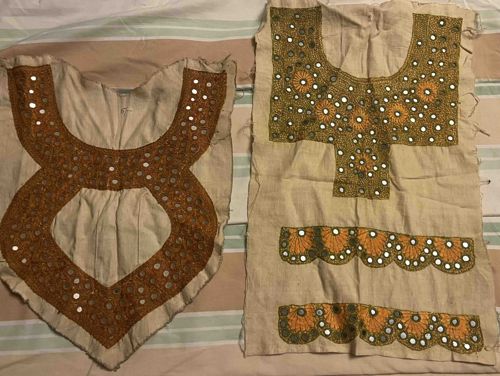
These are two separate, unfinished textile pieces, likely intended as components for traditional garments, possibly blouses or tunics. Both pieces are made from a natural, undyed, coarse-weave fabric, possibly linen or a cotton-linen blend, exhibiting a light beige or off-white color. The fabric shows some visible creasing and slight discoloration consistent with age and storage, but no major tears or holes are apparent. The edges are raw and unfinished, indicating they are either works in progress or deconstructed elements.
The piece on the left features a distinct, 'U'-shaped neckline design with a broader 'X' or bow-like element extending outwards from the bottom of the 'U'. This entire embroidered section is executed in a rich, dark golden-brown thread, with a dense, textured stitchwork, possibly chain stitch or couching, creating a raised effect. Embedded within this embroidery are numerous small, circular mirrors ('shisha' embroidery), meticulously stitched around their edges with coordinating thread. The mirrors themselves appear round and reflective, showing minor signs of dulling but generally intact. The overall dimensions are difficult to ascertain without a scale, but it appears to be a front panel for an upper body garment.
The piece on the right is rectangular and much larger, depicting multiple embroidered sections. The prominent upper section forms a boat-neck or wide 'U'-neckline shape, extensively decorated with embroidery and shisha mirrors. The embroidery here is in a vibrant golden-yellow and a darker olive-green thread, forming floral or abstract circular motifs with centers often highlighted by mirrors. Surrounding these motifs are numerous smaller mirrors, each individually secured. Below this main neck panel are two horizontal, scalloped border sections, also heavily embroidered with the same golden-yellow and olive-green threads and adorned with mirrors. These borders feature a repeating fan or petal-like design. The stitching throughout both pieces appears to be hand-done, characterized by slight variations in tension and spacing, indicative of artisanal craftsmanship rather than machine production. The quality of the mirror work and embroidery is high, demonstrating considerable skill and patience. There are no discernible maker's marks or signatures. Given the style of embroidery and the use of shisha mirrors, these pieces strongly suggest an origin in South Asia, likely from regions known for traditional needlework such as India, Pakistan, or Afghanistan. They likely date from the mid-to-late 20th century, though an earlier origin is possible depending on specific regional styles.
AI Appraisal Report
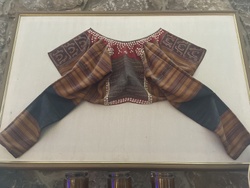
Upon examining the provided images of these two textile pieces with shisha mirrors, I assess their condition as good for their age, exhibiting typical signs of wear, creasing, and minor discoloration consistent with vintage textiles, but no apparent major damage. The raw edges suggest they are either unfinished components or deconstructed elements. The hand-done embroidery and meticulous shisha mirror work indicate artisan craftsmanship.
Authenticity: Based on the visual evidence, the materials (coarse-weave fabric, gold-brown and multi-colored threads) and techniques (shisha embroidery) are highly consistent with traditional South Asian textile arts, likely originating from India, Pakistan, or Afghanistan. The individual variations in stitching further support this. Due to the high skill level, these could be mid-to-late 20th century, though without further information, an earlier dating cannot be excluded.
Market Conditions & Comparables: The market for vintage ethnic textiles, particularly those with intricate hand embroidery and mirror work, remains niche but stable among collectors of folk art, textile historians, and designers. Comparable unfinished or deconstructed garments from this region and period typically range from $100-$300 for individual components, depending on complexity and condition. The presence of two distinct pieces, possibly from different garments or phases of production, adds to their collective appeal.
Demand & Rarity: These pieces possess moderate rarity. While shisha embroidery is not uncommon, well-preserved, unused or deconstructed garment components of this size and quality are less frequently encountered than finished items. Demand primarily comes from collectors and textile artists interested in studying traditional techniques or incorporating authentic vintage elements into contemporary creations.
Factors Impacting Value: The high quality of the embroidery and mirror work is the primary value driver. The pieces' potential use as research material or decorative elements also enhances their worth.
Limitations: My assessment of authenticity and age is based solely on visual evidence. A definitive authentication would require in-person examination to assess fabric type, thread composition, and embroidery techniques under magnification. Provenance documentation (e.g., origin, collection history) would significantly aid in precise dating and attribution. Scientific testing of fibers and dyes could also provide a more accurate age determination.