These notes were written by the person who submitted this item. Appraiser.AI has not verified them, and the AI's identification and estimate may rely on them.
AI Estimated Value
Not an official valuation
$25 - $75
AI estimate as of November 9, 2025 · verify with a professional before acting
AI-Generated · Verify before acting
Everything on this page is generated by AI for informational purposes only. AI can make mistakes — the AI may misidentify items or misattribute them (artist, maker, brand, designer, origin, era). This is not an official valuation and should not be used for insurance, sale, tax, estate, legal, or lending purposes — or any decision requiring a certified appraisal. It is not an authoritative claim about any person, brand, or rights holder — do not share or rely on it as a factual statement about a third party. Always consult qualified professionals before making financial decisions.
This analysis also relies on unverified notes provided by the user, which may be incomplete or inaccurate and could affect the result.
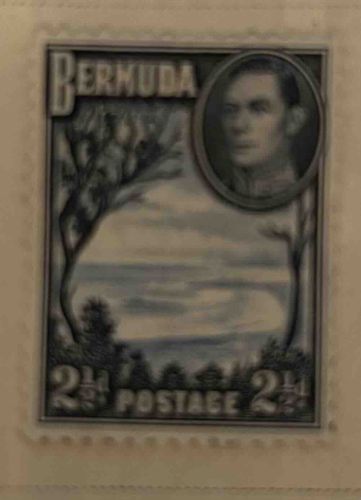
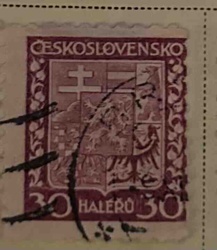
This item is a postage stamp, likely from Bermuda, featuring a monochromatic design in shades of grey and blue. The stamp's central motif depicts a tranquil landscape scene, possibly a coastal or island vista with rolling hills or an open body of water under a cloudy sky. Flanking the landscape are two tree-like structures with bare or sparsely leaved branches, framing the central image in an elegant, stylized manner. In the upper left corner, the word 'BERMUDA' is prominently displayed in a bold, sans-serif font, oriented vertically along the left edge. A circular medallion portrait of a man, presumably King George VI given the likely era, occupies the upper right portion of the stamp. He appears to be depicted in profile or a slight turn, wearing what could be a military uniform. The denomination '2½d' is clearly visible in both the bottom left and bottom right corners, indicating a value of two and a half pence. The word 'POSTAGE' is centered along the bottom edge of the stamp, between the two denomination markings. The stamp features perforated edges, characteristic of most philatelic items, indicating it was intended to be separated from a sheet. The overall condition appears good, with clear printing and no immediately obvious major tears, creases, or significant discoloration, although some minor wear consistent with its age may be present. The color palette suggests an early to mid-20th-century issuance, correlating with the reign of King George VI (1936-1952). The craftsmanship appears to be of standard philatelic quality for the period, with fine line work and details in the engraving.
AI Appraisal Report
I have examined the image provided of the Bermuda 2½d Postage Stamp, King George VI. Based on the visual evidence, the stamp appears to be authentic for its type, displaying the correct design elements, typography, and perforations consistent with Bermuda issues from the King George VI era (1936-1952). The central motif of a tranquil landscape, the 'BERMUDA' inscription, the King's portrait, and the '2½d POSTAGE' denomination are all clearly visible and align with known examples of this stamp.
The overall condition appears good, with clear printing and no immediately obvious major tears, creases, or significant discoloration. However, as I've only reviewed an image, I cannot definitively assess the presence of minor wear, thins, toning, or hidden faults such as creasing or repairs. These elements, if present, could significantly impact the stamp's value.
This specific 2½d denomination from Bermuda during King George VI's reign is generally common. While popular with British Commonwealth collectors, its rarity is low due to large printing quantities. Current market conditions show a consistent but not exceptionally high demand for such common issues in average to good condition.
To provide a full authentication and a more precise appraisal, an in-person examination is crucial. This would allow me to verify the paper type, watermarks (if any), gum condition (mint examples), precise perforation count, and inspect for subtle flaws not discernible in photographs. Additionally, provenance documentation, if available, could add to its verifiable history, although it is less critical for common issues like this one.