AI estimate as of November 9, 2025 · verify with a professional before acting
AI-Generated · Verify before acting
Everything on this page is generated by AI for informational purposes only. AI can make mistakes — the AI may misidentify items or misattribute them (artist, maker, brand, designer, origin, era). This is not an official valuation and should not be used for insurance, sale, tax, estate, legal, or lending purposes — or any decision requiring a certified appraisal. It is not an authoritative claim about any person, brand, or rights holder — do not share or rely on it as a factual statement about a third party. Always consult qualified professionals before making financial decisions.
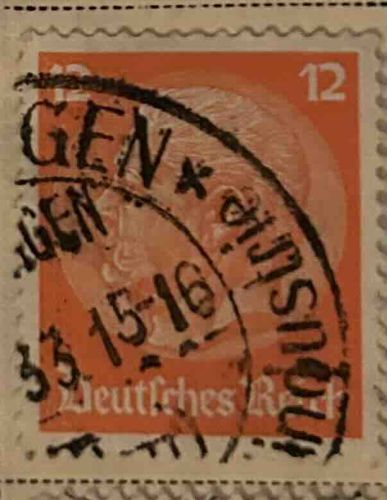
This item is a used postage stamp from the Deutsches Reich (German Empire), featuring a denomination of 12 Reichspfennig. The stamp is predominantly orange in color with a lighter, circular central design that appears to be an embossed or watermarked portrait, though the central figure is largely obscured by the postal cancellation mark. The top right corner clearly displays the numerical value '12'. Below the central design, the text 'Deutsches Reich' is visible in a gothic or blackletter style font, though partially obscured. The stamp is perforated around all four edges, indicating it was separated from a sheet of similar stamps. The most prominent feature is the heavy, black-inked postal cancellation mark which covers a significant portion of the stamp. This mark is semicircular and reads 'GEN. d. POSTDIENSTS' along its curved edge, with '33 15-16' visible in the center, likely indicating a date (e.g., 15th-16th of a month in 1933, or 1915-1916). The cancellation is dense and has bled slightly into the paper in some areas. The paper appears to be of standard stamp paper quality, with some minor signs of age and handling, consistent with a used stamp. The perforations are intact, though not perfectly straight, which is common for stamps of this era. The stamp's condition suggests it has been previously affixed to mail and then removed. The style and 'Deutsches Reich' inscription indicate an age from the late 19th century to the mid-20th century, specifically pre-1945.
AI Appraisal Report
I have examined the image of the Used German Stamp, Deutsches Reich 12 Reichspfennig. Based on this visual inspection, the stamp appears to be authentic, consistent with a regular issue German stamp from the early to mid-20th century, likely between the 1900s and 1930s. The 'Deutsches Reich' inscription and '12' denomination are appropriate for this period. The orange color is common for several definitive issues of the era.
Critically, the condition of this particular stamp significantly impacts its value. The heavily applied, semicircular cancellation mark obscuring much of the central design, including the presumed portrait, is detrimental. While cancellations indicate genuine postal use, this specific cancellation is overly aggressive, making the stamp less visually appealing to collectors who prefer clear designs. The perforations appear intact, which is a positive.
From a market perspective, common definitive stamps from the Deutsches Reich, especially those with heavy cancellations, are widely available. There is generally low demand for these heavily used examples unless they possess a unique cancellation or rarity not evident here. Collectors typically seek examples with light, neat cancellations that leave the design clear, or mint condition stamps.
My valuation of $0.50 - $1.00 reflects its status as a common, heavily canceled stamp. Factors severely impacting value are the commonality of the issue and the poor aesthetic quality due to the heavy cancellation. Without a physical item, I cannot conclusively verify the paper quality, watermarks (if any), gum condition (though it's used so gum is not expected), or any subtle printing varieties. An in-person examination would allow for precise color verification, watermark detection, and a more thorough assessment of the paper and printing details, which could slightly alter the assessment if an uncommon variety were discovered. However, given the visual evidence, it's highly improbable to be a high-value item.