AI estimate as of November 10, 2025 · verify with a professional before acting
AI-Generated · Verify before acting
Everything on this page is generated by AI for informational purposes only. AI can make mistakes — the AI may misidentify items or misattribute them (artist, maker, brand, designer, origin, era). This is not an official valuation and should not be used for insurance, sale, tax, estate, legal, or lending purposes — or any decision requiring a certified appraisal. It is not an authoritative claim about any person, brand, or rights holder — do not share or rely on it as a factual statement about a third party. Always consult qualified professionals before making financial decisions.
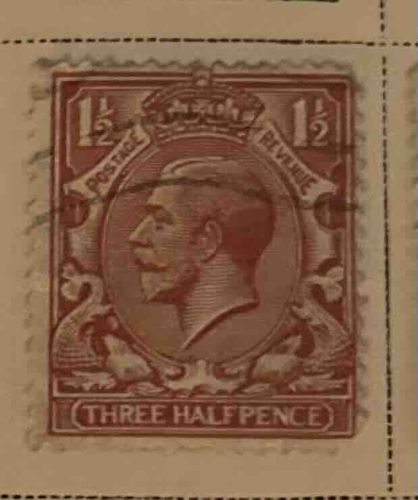
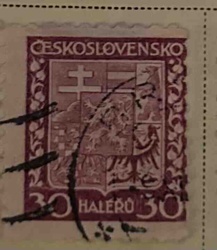
This item is a vintage postage and revenue stamp featuring a profile portrait of King George V. The stamp is predominantly reddish-brown or sepia-toned, with detailed engraving. The central motif is an oval vignette depicting a left-facing bust of King George V, characterized by his distinctive mustache and beard. Above the portrait, a royal crown is prominently displayed, flanked by banners that read 'POSTAGE' on the left and 'REVENUE' on the right, both curving around the oval. The denomination '1 1/2' (one and a half) is visible in each upper corner, within small rectangular boxes. Below the portrait, across the bottom edge of the stamp, is a horizontal bar with the text 'THREE HALFPENCE'. Stylized decorative elements, possibly resembling wings or heraldic beasts, frame the lower sides of the oval portrait. The stamp is rectangular in shape and appears to be made of paper, typical for philatelic items. The edges show characteristic perforations, indicating it was part of a larger sheet. While the overall condition appears good, with clear printing and no apparent major tears, the image quality limits a precise assessment of any minor creases, fading, or foxing. Notably, the perforations on the right side appear to be well-defined, while the left side is partially obscured by the background. This stamp belongs to the early to mid-20th century, consistent with the reign of King George V (1910-1936). The craftsmanship suggests a high standard of engraving and printing for official government issues.
AI Appraisal Report
Upon examining the provided image of the King George V 'Three Halfpence' Postage and Revenue Stamp, I assess its condition as generally good, with clear printing and visible perforations. The design elements, including the portrait, crown, and text, are crisp and well-defined, suggesting authenticity based on visual characteristics. However, limitations inherent in image-based appraisal prevent a definitive assessment of minor flaws such as subtle creases, thinning, pinholes, or foxing that might impact its grade. The perforations appear consistent with the issue, though the left side is partially obscured.
From a market perspective, King George V stamps are common, especially standard definitive issues like the 'Three Halfpence.' These stamps were produced in vast quantities, making them readily available to collectors. Comparables on the market typically fall into a modest price range unless they possess specific distinctions such as rare plate flaws, unusual cancellations, or are in pristine, unmounted mint condition with full original gum.
Demand for this particular common definitive is generally stable but low, primarily driven by beginner collectors or those completing basic George V collections. It lacks the rarity that commands significant prices. The monetary value is therefore heavily dependent on its exact condition, gum status, and any certified unique characteristics not discernible here.
For full authentication and a precise valuation, an in-person examination is crucial. This would allow me to assess gum condition, paper variations, watermarks, exact perforation measurements, and any hidden repairs or faults. Provenance documentation, though less common for such a ubiquitous stamp, could also corroborate its history. Scientific testing, such as spectrometric analysis of inks or paper, would be excessive and unnecessary for this common issue, typically reserved for high-value rarities where counterfeiting is a significant concern.