AI estimate as of November 8, 2025 · verify with a professional before acting
AI-Generated · Verify before acting
Everything on this page is generated by AI for informational purposes only. AI can make mistakes — the AI may misidentify items or misattribute them (artist, maker, brand, designer, origin, era). This is not an official valuation and should not be used for insurance, sale, tax, estate, legal, or lending purposes — or any decision requiring a certified appraisal. It is not an authoritative claim about any person, brand, or rights holder — do not share or rely on it as a factual statement about a third party. Always consult qualified professionals before making financial decisions.
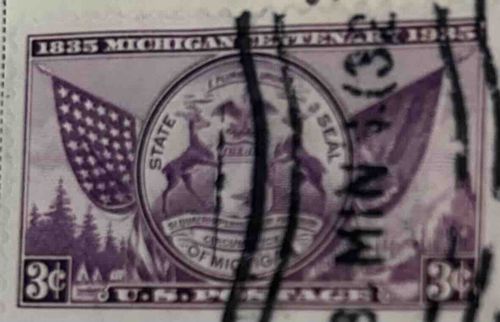
This item is a 3-cent United States postage stamp commemorating the Michigan Centenary, issued in 1935. The stamp is predominantly purple or violet in color and features a central circular motif of the State Seal of Michigan. The seal depicts two deer, one on each side, supporting a shield with 'E PLURIBUS UNUM' above it, and a sun rising over a body of water in the background. The words 'STATE SEAL OF MICHIGAN' are visible around the perimeter of the seal. Flanking the central seal are two flags; on the left, the American flag is shown, and on the right, what appears to be another banner or flag. In the foreground, below the flags, there are evergreen trees or a forest scene. The top border of the stamp features the inscription '1835 MICHIGAN CENTENARY 1935'. The denomination '3¢' is prominently displayed in the bottom left and bottom right corners. The words 'U.S. POSTAGE' are printed across the bottom center. The stamp shows clear signs of having been used, evidenced by multiple heavy black ink cancellations crisscrossing the design. These cancellation marks obscure some of the finer details of the central seal and the right flag. The overall condition appears used, with the cancellations being the most dominant characteristic affecting its visual appeal and potentially its collectible value. The stamp's edges appear perforated, typical of philatelic items of this era. The paper quality seems standard for postage stamps of the early 20th century.
AI Appraisal Report
I have examined the provided image of the 1935 Michigan Centenary 3-Cent US Postage Stamp. This stamp, Scott #777, commemorates 100 years of Michigan's statehood. My appraisal is based solely on the visual examination of the image provided; a physical inspection would be necessary for a definitive assessment.
Condition: The stamp is clearly used, as evidenced by heavy black ink cancellations that obscure significant portions of the design, particularly the central seal and the right flag. While perforations appear intact, the heavy cancellation significantly detracts from its aesthetic appeal and collectible value. There are no obvious tears, creases, or thinning visible from the image, but these would require in-hand inspection.
Authenticity: Based on the visual characteristics, including the design, denomination, and inscriptions, the stamp appears to be an authentic 1935 Michigan Centenary issue. However, without physical examination, I cannot definitively rule out sophisticated counterfeits or alterations. Magnification would be needed to inspect printing details and paper characteristics.
Market Conditions & Comparables: This is a common commemorative stamp. Used examples in average condition typically sell for very little. Online marketplaces and stamp dealer catalogs show similar heavily canceled examples fetching prices in the range of a few cents to a quarter.
Demand & Rarity: This stamp is neither rare nor in high demand among collectors, especially in a heavily canceled state. It is considered a common philatelic item.
Factors Impacting Value: The most significant factor impacting this stamp's value is its heavily canceled condition. A pristine, uncirculated (mint) example would command a higher, though still modest, price. Centering, color, and precise cancellation style can also influence value, but the overall heavy cancellation here overshadows these.
Limitations: My assessment of authenticity and condition is limited by examining an image alone. A physical inspection would allow me to check paper quality, gum (if present), watermarks, precise perforations, and any hidden flaws. Verifying authenticity with absolute certainty often requires in-person examination by a philatelic expert, potentially alongside scientific testing to analyze ink or paper if warranted, for any reason, counterfeiting was suspected for such a common issue.