AI estimate as of August 24, 2025 · verify with a professional before acting
AI-Generated · Verify before acting
Everything on this page is generated by AI for informational purposes only. AI can make mistakes — the AI may misidentify items or misattribute them (artist, maker, brand, designer, origin, era). This is not an official valuation and should not be used for insurance, sale, tax, estate, legal, or lending purposes — or any decision requiring a certified appraisal. It is not an authoritative claim about any person, brand, or rights holder — do not share or rely on it as a factual statement about a third party. Always consult qualified professionals before making financial decisions.
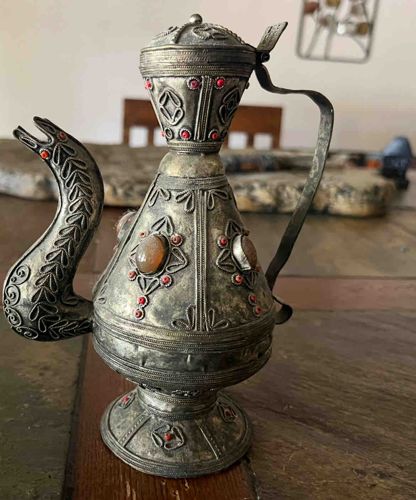
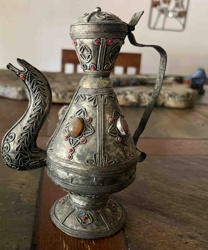
This item is an ornate metallic ewer or pitcher, likely of Middle Eastern or North African origin, crafted from a silver-toned metal, possibly a base metal like white metal or pewter with a silver wash or plating, exhibiting significant patination and tarnish. Its approximate height appears to be around 10-14 inches, and it sits on a flared, round pedestal base. The body is bulbous at the bottom, tapering to a narrower neck, then flaring out to a domed lid with a small finial. The vessel features extensive repoussé and chased decoration, including stylized floral and geometric patterns. Both the main body and the lid are adorned with numerous small, round, red cabochon stones (likely glass or dyed beads) set within bezels, often forming clusters or borders around larger, oval-shaped, light brown or amber-colored cabochon stones. These larger stones appear translucent and show natural inclusions, suggesting they could be agates or similar semi-precious stones. The spout is highly stylized, resembling a serpent or dragon's head, with incised patterns mimicking scales or intricate foliage, and has red stones accentuating the 'mouth' area. A curved, flat metal handle with a simple, utilitarian form extends from the upper body to the neck, attached by rivets or soldering. The overall construction appears robust, though the visible tarnish and some minor surface irregularities suggest age and consistent handling. There are no immediately discernible maker's marks or signatures. The craftsmanship suggests a folk art or artisan-made piece rather than mass production, indicative of traditional metalworking techniques. The patina is uneven, with darker areas in recessed details and lighter areas where the metal has been rubbed, enhancing the antique aesthetic. The condition suggests minor wear consistent with age and use, but no significant damage like dents or cracks are visible.
AI Appraisal Report
This ornate metal ewer presents as a captivating piece, likely of Middle Eastern or North African origin, exhibiting characteristics typical of artisan-crafted metalware from the late 19th to early 20th century. The silver-toned metal, though heavily tarnished, suggests a base metal construction with a plating or wash, consistent with similar decorative items from the region. Its condition appears good for its age, showing expected wear, tarnish, and surface irregularities without obvious major damage like deep dents or cracks. The intricate repoussé and chased decoration, along with the distinct cabochons—red likely glass, and larger amber-colored possibly agate—underscore its decorative appeal. The stylized serpent-head spout is a particularly appealing design element.
Market conditions for such ethnic decorative arts are stable, driven by collectors of world antiquities and unique accent pieces. While not extremely rare, well-preserved examples with engaging aesthetics, like this ewer, consistently find buyers. Comparables include other Middle Eastern/North African ewers, often listed in the $200-$600 range depending on material, craftsmanship, and condition. The absence of maker's marks, while typical for folk art, does limit precise attribution. The decorative stones, particularly the larger amber ones, enhance its visual appeal and value.
My primary limitation in authenticity verification from images alone is the inability to perform a hands-on examination of the metal composition, stone types, and construction techniques. A physical inspection would allow for detailed analysis of the metal's patina, assessment of stone authenticity (e.g., specific gravity or refractive index for the amber-colored stones), and direct examination of joins and applied elements for signs of repair or original craftsmanship. Provenance documentation, if available, would significantly enhance its value by confirming its history and origin. Scientific testing, such as X-ray fluorescence (XRF) for metal composition, could definitively identify the alloys used.