These notes were written by the person who submitted this item. Appraiser.AI has not verified them, and the AI's identification and estimate may rely on them.
AI Estimated Value
Not an official valuation
$400-600
AI estimate as of July 16, 2025 · verify with a professional before acting
AI-Generated · Verify before acting
Everything on this page is generated by AI for informational purposes only. AI can make mistakes — the AI may misidentify items or misattribute them (artist, maker, brand, designer, origin, era). This is not an official valuation and should not be used for insurance, sale, tax, estate, legal, or lending purposes — or any decision requiring a certified appraisal. It is not an authoritative claim about any person, brand, or rights holder — do not share or rely on it as a factual statement about a third party. Always consult qualified professionals before making financial decisions.
This analysis also relies on unverified notes provided by the user, which may be incomplete or inaccurate and could affect the result.
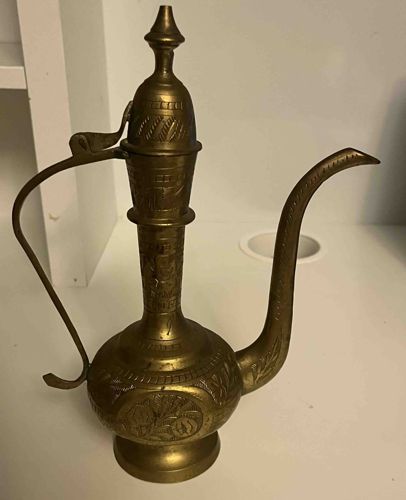
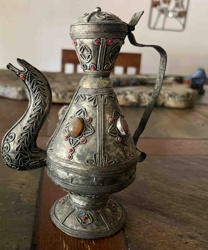
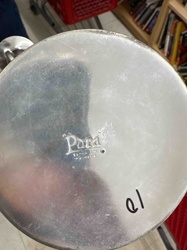
This item is an antique or vintage Indo-Persian style ewer or ritual pouring vessel, crafted from brass or a brass alloy, exhibiting a warm, aged golden-brown patina. Its overall height appears to be approximately 10-14 inches, with a slender neck flaring out into a globular body, supported by a flared circular base. The vessel features a distinct, elongated, curved spout emanating from the lower part of the body, and a gracefully arced handle attached near the base and extending upwards to just below the lid. The handle has a single, simple curve and a slight flat-bottomed hook where it connects to the body. A hinged, domed lid, topped with a pointed finial, covers the opening. The surface of the ewer is adorned with intricate etched or engraved patterns. The lid and the upper part of the neck display bands of geometric and possibly repeating foliate motifs, resembling fish scales or stylized leaves. The main body of the vessel features more elaborate, circular medallions containing figural or mythological scenes, possibly depicting animals or human-like figures within a naturalistic setting, enclosed by ornate borders. There are also bands of decorative etching immediately above these medallions and on the widest part below the neck. The craftsmanship suggests a hand-etched process, adding to its artisanal quality. The metal shows signs of age, including areas of darkening patina, minor superficial scratches, and possibly some small dents consistent with its age and use. There are no obvious signs of significant damage, repairs, or structural integrity issues visible in the provided images. The presence of '13' etched on the bottom could be a production number, inventory mark, or a personal engraving, which would need further investigation. The style strongly points to an Eastern origin, likely Indian or Middle Eastern, and suggests an age from the late 19th to early 20th century due to the observed patina and typical craftsmanship of such decorative brassware.
AI Appraisal Report
Upon my virtual examination of this Indo-Persian style brass ewer, I note its elegant form, consistent with ritual pouring vessels from the Eastern decorative arts tradition. The brass, exhibiting a warm, aged golden-brown patina, strongly suggests late 19th to early 20th-century craftsmanship. The intricate etched patterns, particularly the bands of geometric and foliate motifs, and the more elaborate circular medallions on the body depicting what appear to be figural or mythological scenes, are characteristic of hand-etched pieces from India or the Middle East. The overall condition appears good for its age, with expected signs of use and time, such as darkening patina and minor superficial scratches. There are no visible major damages or repairs. The '13' etched on the bottom is intriguing; it could be a production ID, inventory mark, or personal engraving, but without further context, its meaning is speculative.
From a market perspective, comparable Indo-Persian brassware, especially pieces with detailed figural etching, are consistently sought after by collectors of Eastern decorative arts and global antiques. The demand for such pieces remains steady, driven by their aesthetic appeal and historical significance. While not exceedingly rare, a well-preserved piece with fine detail, as this appears to be, holds greater value. The ewer's substantial size (10-14 inches) also adds to its display potential, enhancing its desirability.
However, it is crucial to state the limitations of an appraisal based solely on images. Authentic age and exact origin are best verified through in-person examination, allowing for a tactile assessment of the metal's weight, the patination's depth, and the etching technique's nuances. Microscopic analysis could reveal finer details of craftsmanship and potential restorations. Provenance documentation, such as receipts or family histories, would significantly strengthen claims of authenticity and historical context, greatly impacting value. Scientific testing, if applicable, could confirm the alloy composition. Without these, my authentication is based on visual cues and typical stylistic indicators. The current market condition for antique decorative brassware is stable, with quality pieces commanding fair prices.