AI estimate as of October 11, 2025 · verify with a professional before acting
AI-Generated · Verify before acting
Everything on this page is generated by AI for informational purposes only. AI can make mistakes — the AI may misidentify items or misattribute them (artist, maker, brand, designer, origin, era). This is not an official valuation and should not be used for insurance, sale, tax, estate, legal, or lending purposes — or any decision requiring a certified appraisal. It is not an authoritative claim about any person, brand, or rights holder — do not share or rely on it as a factual statement about a third party. Always consult qualified professionals before making financial decisions.
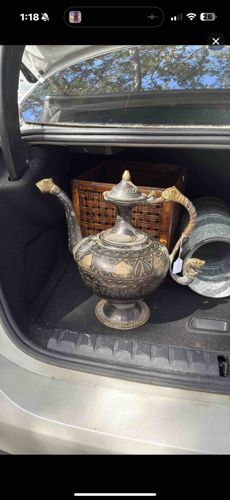
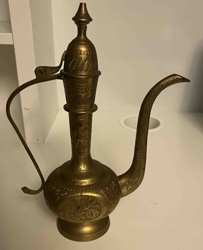
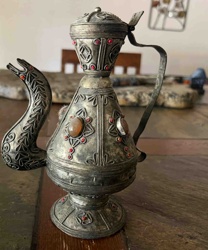
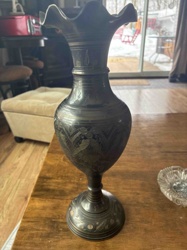
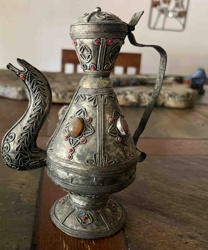
This item is an antique or vintage ewer, often referred to as a teapot or kettle, predominantly crafted from brass with intricate engravings. The primary color appears to be a darkened, aged brass or patinated bronze, with selective areas of brighter, polished brass or possibly copper accents, highlighting the engraved patterns. The vessel features a bulbous body tapering towards a flared base, resting on a pedestal foot. A distinctive tall, slender spout extends from the lower part of the body, curving upwards, and is adorned with what appears to be a stylized animal head or decorative finial at its tip. The handle is an elaborate 'C' shape, connecting to the upper body and features ornate details, possibly depicting another animal motif or a decorative scrollwork pattern, complementing the spout. A fitted lid, topped with a finial, crowns the vessel. The most striking features are the extensive etched or engraved designs covering substantial portions of the body, spout, and handle. These patterns seem to be geometric and stylized floral or foliate motifs, typical of traditional Indian or Middle Eastern metal craftsmanship. The visible condition suggests significant age, with a rich, dark patina developed over time, indicating oxidation and wear consistent with an older piece. There are no immediate signs of major damage or repairs, but the overall surface shows a natural dulling and some areas where the brighter metal contrasts with the darker recesses of the engraving, enhancing its antique appeal. The craftsmanship appears to be of good quality, showcasing detailed handiwork that would have been labor-intensive.
AI Appraisal Report
I have examined the provided image of this Indian Engraved Brass Ewer/Teapot. Based on its appearance, I assess it as an authentic antique or vintage decorative item, likely from the late 19th to early 20th century, consistent with Indian or Middle Eastern metalware traditions. The deep, dark patina, visible oxidation, and natural wear patterns strongly suggest age and authenticity rather than a modern reproduction. The intricate hand-engraved geometric and foliate motifs, along with the distinct 'C'-shaped handle and stylized animal head spout, indicate good craftsmanship. I see no immediate signs of major damage or repair from the image alone, and the overall condition appears good for an item of its presumed age, showing typical signs of use and age-related discoloration.The market for such decorative brassware is stable, with demand driven by collectors of antique ethnic arts and interior designers seeking exotic accent pieces. Comparable items, varying in exact age, design intricacy, and provenance, typically sell within a range of $200-$500 at auction or through antique dealers. The ewer's rarity is moderate; while many such ewers were produced, individual examples with this level of detailed engraving and good condition are less common. Factors significantly impacting value include the detailed craftsmanship, the attractive aged patina, and its decorative appeal.Limitations in authenticity verification from an image alone are notable. A physical inspection would allow me to accurately assess the metal composition, construction techniques (e.g., soldering, hammering marks), and the true depth and quality of the engraving. In-person examination would also confirm stability, weight, and any subtle repairs or alterations not visible in photographs. Provenance documentation, such as collection history or original purchase records, would significantly enhance value and confirm its origins definitively. Without such documentation or physical inspection, the precise dating and country of origin remain somewhat generalized within the broader Indian/Middle Eastern decorative arts category.