AI estimate as of September 7, 2025 · verify with a professional before acting
AI-Generated · Verify before acting
Everything on this page is generated by AI for informational purposes only. AI can make mistakes — the AI may misidentify items or misattribute them (artist, maker, brand, designer, origin, era). This is not an official valuation and should not be used for insurance, sale, tax, estate, legal, or lending purposes — or any decision requiring a certified appraisal. It is not an authoritative claim about any person, brand, or rights holder — do not share or rely on it as a factual statement about a third party. Always consult qualified professionals before making financial decisions.
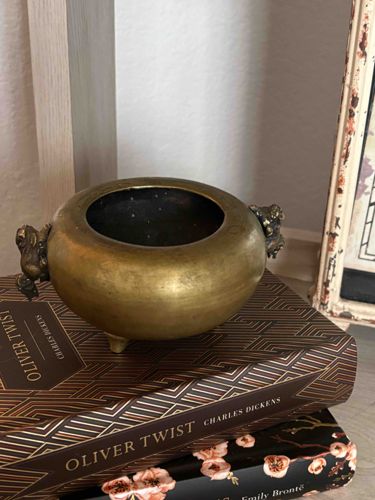
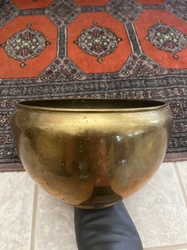
This item is a small, heavy-looking brass vessel, likely functioning as a censer or incense burner due to its open top and general form. It features a spherical or globular body, supported by three short, tapered feet that are barely visible but discernible beneath the base. The material appears to be solid brass, exhibiting a warm, aged golden color with visible areas of patina and slight discoloration, suggesting a natural aging process rather than recent polishing. The surface has a relatively smooth, matte to subtly reflective finish, indicating some wear or a pre-treated surface.
Distinguishing features include two ornate handles, symmetrically placed on opposite sides of the vessel's rim. These handles are crafted in the form of stylized beast or animal heads, possibly lions or mythical creatures, with detailed facial features and mane-like textures. The craftsmanship of these handles appears to be robust, possibly cast, and they show a darker, more oxidized patina compared to the main body, highlighting their intricate details. The open top reveals a dark, possibly soot-stained interior, consistent with its likely use for burning materials. There are no visible maker's marks, signatures, or specific manufacturing stamps in the provided image.
Its classical, somewhat oriental-inspired design, combined with the material and visible patina, suggests an estimated age from the late 19th to mid-20th century, though it could potentially be older. The quality of craftsmanship appears to be good, with solid construction and well-executed details on the handles, indicating a piece made with care, rather than mass-produced. The overall condition shows age-appropriate wear and patina, but no immediate signs of significant damage like cracks or dents are apparent.
AI Appraisal Report
Based on my visual examination of the provided image, this brass tripod censer appears to be in good, age-appropriate condition. The visible patina and slight discoloration are consistent with natural aging, confirming its likely authenticity as an older piece, rather than a modern reproduction attempting to mimic age. The craftsmanship on the beast-head handles is a particular highlight, showing good detail and solid construction.
Market conditions for such decorative brass metalware are generally steady but not experiencing significant surges. Similar censers, often of Asian or classical European inspiration, appear regularly at estate sales and smaller auction houses. Comparables suggest a moderate value, especially for pieces without notable provenance or definitive historical attribution. While the piece exhibits good quality, it does not appear to possess the exceptional artistic merit or extreme rarity that would command a premium.
Factors impacting value include its age, likely late 19th to mid-20th century, which places it within a common collecting period. The lack of visible maker's marks limits its direct attribution, preventing association with known workshops or artists that would significantly increase its value. Its primary value lies in its decorative appeal and functional design as a censer.
It is crucial to note the limitations of appraising from images alone. While visually authentic, a full in-person examination would be necessary to confirm the exact material composition, assess the internal condition more thoroughly (e.g., integrity of the base), and search for any faint, obscured marks. Provenance documentation, if available, would be vital for definitive authentication of origin or historical significance. Scientific testing, such as material analysis, could provide more precise dating and confirm metal composition, further solidifying authenticity and potentially pinpointing its origin more accurately.