AI Appraisal Estimate

AI-generated estimates · not official valuations

From the user

What was submitted

Photo and notes provided by the user — not generated by AI

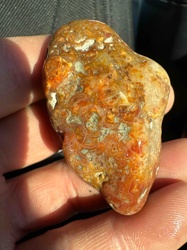
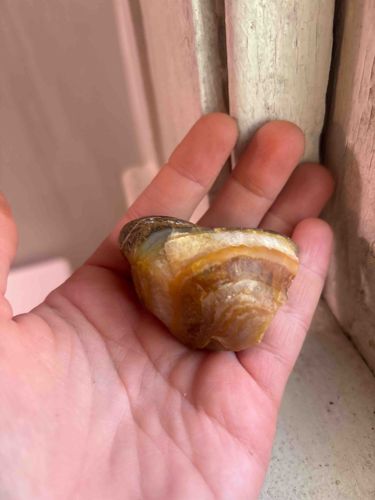
Submitted item photo
Submitted photo · June 17, 2026

User's notes

No additional notes provided.

AI analysis below

AI appraisal

AI analysis & estimate

AI-Generated · Verify before acting

Everything below is generated by AI for informational purposes only. AI can make mistakes — the AI may misidentify items or misattribute them (artist, maker, brand, designer, origin, era). This is not an official valuation and should not be used for insurance, sale, tax, estate, legal, or lending purposes — or any decision requiring a certified appraisal. It is not an authoritative claim about any person, brand, or rights holder — do not share or rely on it as a factual statement about a third party. Always consult qualified professionals before making financial decisions.

Read the full disclaimer

AI Identification

·Not independently authenticated·Verify before acting

Polished Banded Agate Nodule

Rocks, Fossils & Minerals

AI Estimated Value

·Not an official valuation·Verify before acting

$25.00 - $45.00

As of June 17, 2026

AI Item Analysis

·AI can make mistakes·Verify before acting
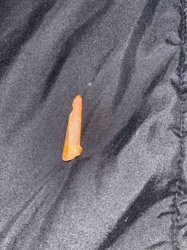
This specimen is a natural banded agate nodule, likely a variety of Lake Superior or carnelian-style agate, held in a person's hand for scale (approximately 2 to 2.5 inches in length). The stone displays classic microcrystalline quartz characteristics with distinct concentric banding. The color palette is rich and warm, featuring translucent layers of honey-amber, deep butterscotch, and creamy white, with a subtle hint of grayish-blue chalcedony near the top. The surface appears to have a semi-polished or naturally smooth waxy texture, suggesting it may have been tumbled or water-worn. The physical construction is a solid, dense mineral mass with a slightly irregular, rounded shape. Notable features include the high contrast between the opaque yellow-orange bands and the more translucent internal layers. Regarding condition, the stone shows some natural surface pitting, micro-fractures, and minor chips along the edges, which are common for raw or lightly processed gemstones. There are no visible maker's marks, as it is a natural geological formation. The quality is indicative of a high-grade collector's specimen due to the clarity of the banding and the saturation of the iron-oxide-derived coloring. Its age dates back millions of years to the volcanic activities that formed the air bubbles in which these crystals grew.
AI Appraisal Report

·AI can make mistakes·Verify before acting
I have virtually examined this polished banded agate nodule, measuring approximately 2 to 2.5 inches. The specimen exhibits the characteristic concentric banding and 'fortification' patterns consistent with a high-quality Lake Superior or Brazilian-type agate. The coloration is vibrant, ranging from honey-amber to creamy white, signifying a rich iron-oxide infusion during the mineral's formation. Based on the visual inspection, the stone shows a high-gloss polish likely achieved through tumbling, which enhances its aesthetic appeal for collectors. The condition is good, though I noted minor surface pitting and internal micro-fractures; these are typical for natural chalcedony and do not significantly detract from its decorative value. The market for mid-sized agate nodules is currently stable. This specimen is considered a 'collector grade' piece due to the clarity of its bands, though it lacks the extreme rarity of 'eye agates' or large-scale museum specimens which command hundreds of dollars. Comparable items are frequently sold in rock shops and mineral shows within the stated range. Factors limiting the value include its relatively common size and the presence of slight edge chipping. Please note that while the visual characteristics strongly suggest authenticity, a definitive identification of the geographic origin and a check for dye enhancements—common in the agate trade—cannot be confirmed via images alone. Full authentication would require an in-person examination under a gemological microscope to inspect surface reaching fractures for dye residue and a Mohs hardness test. No provenance documentation was provided, which is standard for individual mineral specimens of this type.

Get your items appraised

Instant estimates of your treasures with AI-powered appraisals

Browse More Appraisals