Lake Superior Agate
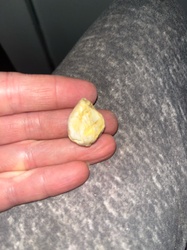
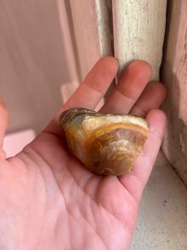
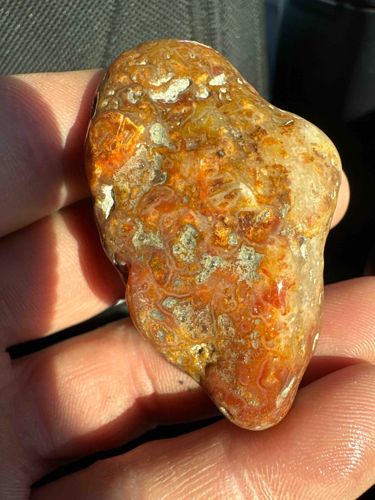
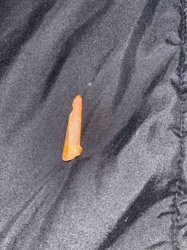
This specimen is a raw, unpolished Lake Superior Agate, held by a hand for scale, approximately 2 to 3 inches in length. It exhibits a complex variety of warm tones including vibrant oranges, deep rust reds, and honey yellows, interspersed with translucent quartz and gray matrix material. The piece displays characteristic 'eye' agate patterns and concentric banding, though many of these details are obscured by the specimen's rough, natural surface texture. The stone appears to have a semi-waxy luster typical of microcrystalline quartz. Several small pits, fractures, and irregular inclusions are visible across the surface, which are common for stones weathered in glacial till or riverbeds. The overall shape is irregular and somewhat oblong, suggesting natural water or ice-driven erosion. Craftsmanship is not applicable as this is a natural geological formation, but the density of the pattern and the saturation of the orange hues indicate a high-quality mineral specimen. There are no signs of human modification like tumbling or cutting. The age of the parent rock dates back to approximately 1.1 billion years ago, formed during the Midcontinent Rift system.
AI-Generated Appraisal Disclaimer
Estimated Value
$45.00 - $75.00
Basic Information
Category
Rocks, Fossils & Minerals
Appraised On
January 13, 2026
Estimated Value
$45.00 - $75.00
Item Description
This specimen is a raw, unpolished Lake Superior Agate, held by a hand for scale, approximately 2 to 3 inches in length. It exhibits a complex variety of warm tones including vibrant oranges, deep rust reds, and honey yellows, interspersed with translucent quartz and gray matrix material. The piece displays characteristic 'eye' agate patterns and concentric banding, though many of these details are obscured by the specimen's rough, natural surface texture. The stone appears to have a semi-waxy luster typical of microcrystalline quartz. Several small pits, fractures, and irregular inclusions are visible across the surface, which are common for stones weathered in glacial till or riverbeds. The overall shape is irregular and somewhat oblong, suggesting natural water or ice-driven erosion. Craftsmanship is not applicable as this is a natural geological formation, but the density of the pattern and the saturation of the orange hues indicate a high-quality mineral specimen. There are no signs of human modification like tumbling or cutting. The age of the parent rock dates back to approximately 1.1 billion years ago, formed during the Midcontinent Rift system.
Related Tags
Get Your Items Appraised
Instant estimates of your treasures with AI-powered instant appraisals