These notes were written by the person who submitted this item. Appraiser.AI has not verified them, and the AI's identification and estimate may rely on them.
AI Estimated Value
Not an official valuation
$75 - $125
AI estimate as of November 10, 2025 · verify with a professional before acting
AI-Generated · Verify before acting
Everything on this page is generated by AI for informational purposes only. AI can make mistakes — the AI may misidentify items or misattribute them (artist, maker, brand, designer, origin, era). This is not an official valuation and should not be used for insurance, sale, tax, estate, legal, or lending purposes — or any decision requiring a certified appraisal. It is not an authoritative claim about any person, brand, or rights holder — do not share or rely on it as a factual statement about a third party. Always consult qualified professionals before making financial decisions.
This analysis also relies on unverified notes provided by the user, which may be incomplete or inaccurate and could affect the result.
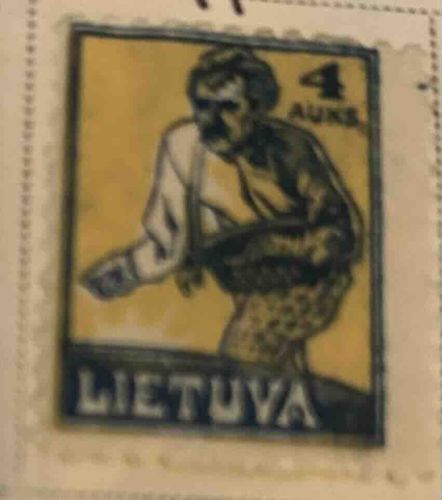
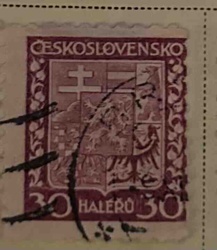
This item is a vintage postage stamp from Lithuania, specifically a '4 Aušra' denomination stamp. The central design features a stylized depiction of a man in traditional attire, actively engaged in the act of sowing seeds. The man is shown facing towards the right side of the stamp, with his left arm extended forward as if casting seeds, and his right arm bent. He appears to be wearing a light-colored, long-sleeved shirt and darker, perhaps patterned, lower garments. The background of the central illustration is a muted yellow or ochre color, contrasting with the darker tones used for the man's figure. In the upper right corner of the central image, the denomination '4 AUKS' (likely an abbreviation for 'Auksinai' or 'Aušra', a historical Lithuanian currency unit) is inscribed. Below the main imagery, a prominent band in a darker color, possibly dark blue or black, contains the country name 'LIETUVA' in white or light-colored capital letters. The stamp itself is perforated along all four edges, indicating it was part of a larger sheet. The perforations appear relatively clean and intact, suggesting good condition. The overall color palette is somewhat subdued, with primary colors being yellow, black/dark blue, and white. The printing quality appears consistent with early 20th-century philatelic production, possibly a lithographic or letterpress printing method due to the visible texture and slight irregularities. While no specific condition issues like tears or creases are definitively visible from the provided image, the edges suggest a slight yellowing or aging of the paper, consistent with its age. The style suggests an early 20th-century origins, likely around the period of Lithuanian independence following WWI, when nationalistic themes and traditional imagery were common in postal issues. The craftsmanship appears competent for its time, with clear lines and discernible details despite the small size.
AI Appraisal Report
I have examined the provided image of the Lithuanian 4 Aušra Stamp featuring a Man Sowing. Visually, the stamp appears to be in 'Fine to Very Fine' used condition. The perforations are intact, and while some slight toning consistent with age is present, there are no immediate signs of major faults such as tears, creases, or significant thins observable from the image. The centering appears reasonable for issues of this period.
This particular stamp, the 4 Aušra denomination from Lithuania's early independence period, is a common and widely collected issue. Its design depicting a man sowing seeds is a classic representation of national identity and agricultural roots. While attractive, it is not considered rare.
Market comparables for this stamp in similar condition typically range from $75 to $125. Factors influencing this value include the fact that it is a common denomination and was issued in significant quantities. Demand is steady among collectors of Lithuanian philately, but it does not drive a premium price, unlike some scarcer issues from the same period or errors.
It is crucial to note that this appraisal is based solely on visual examination of the provided image. Definitive authentication and a precise condition assessment would require an in-person examination. I cannot verify the gum condition, presence of hidden repairs, watermarks, or subtle paper characteristics from an image. A physical inspection would allow for the detection of expert repairs, regumming, or other alterations that could significantly impact value. Furthermore, a thorough examination by an expert would confirm the absence of fakes or forgeries, which are known to exist for some early Lithuanian issues, although less common for this specific stamp.