AI estimate as of November 8, 2025 · verify with a professional before acting
AI-Generated · Verify before acting
Everything on this page is generated by AI for informational purposes only. AI can make mistakes — the AI may misidentify items or misattribute them (artist, maker, brand, designer, origin, era). This is not an official valuation and should not be used for insurance, sale, tax, estate, legal, or lending purposes — or any decision requiring a certified appraisal. It is not an authoritative claim about any person, brand, or rights holder — do not share or rely on it as a factual statement about a third party. Always consult qualified professionals before making financial decisions.
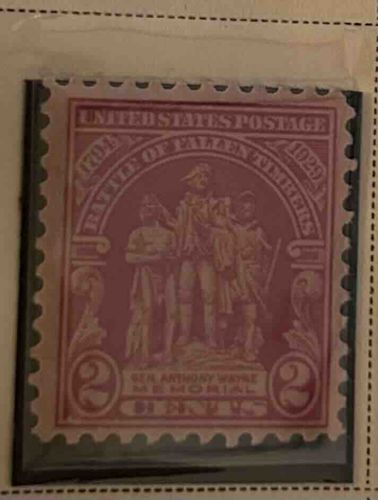
This item is a United States postage stamp, commemorating the 1794 Battle of Fallen Timbers and the General Anthony Wayne Memorial. The stamp features a predominantly reddish-purple coloration, appearing somewhat faded or muted, indicative of its age. Its rectangular shape is typical for postage stamps, with visible perforations along all four edges, suggesting it was once part of a larger sheet. The central design depicts a three-figure sculptural group, likely representing General Anthony Wayne flanked by two other figures, possibly soldiers or allegorical representations, standing on a pedestal. Above this central image, the text 'UNITED STATES POSTAGE' is prominently displayed in an arc, with '1794 BATTLE OF FALLEN TIMBERS 1929' forming a semi-circular banner beneath it. Below the central figures, the words 'GEN. ANTHONY WAYNE MEMORIAL' are present. The denomination '2' appears in circles in both the lower left and lower right corners of the stamp, indicating its two-cent value. The overall impression is that of a commemorative issue from 1929 celebrating a historical event and figure. The stamp is currently housed within a black, plastic or Mylar-like mount, which protects it and suggests it has been stored as part of a stamp collection. The condition of the stamp itself appears relatively good, though the colors show some age-related softening rather than crispness. No obvious tears, creases, or major damage are visible, but the exact paper quality and gum condition cannot be assessed from the provided image. The perforations appear intact, and the printing details, though small, are discernible, pointing to standard intaglio printing methods common for U.S. stamps of this era. This style of commemorative design with historical figures and events was common during the early 20th century.
AI Appraisal Report
Based on my visual examination of the provided image, I have appraised this 1929 2-cent Battle of Fallen Timbers Commemorative Stamp. The stamp appears authentic based on its design, coloration (a muted reddish-purple), and perforations, all consistent with the U.S. Scott #659 issue. The condition seems relatively good; the perforations are intact, and there are no obvious tears or creases from the image. However, the color appears somewhat faded or softened, which is common for stamps of this age and can impact higher grades. It is housed in a standard mount, typical for collectors.
This particular stamp, Scott #659, was printed in large quantities (14,400,000 copies). Consequently, it is not considered rare. Market conditions reflect this high supply with relatively low demand for common, used examples. Therefore, this stamp's value is primarily driven by its condition and whether it is unused (mint, never hinged) or used (canceled).
Given the visible color softening and the strong likelihood of it being a used example (though a cancellation is not clearly visible in the image, the muted color suggests it's not mint pristine), I estimate its value in the range of $0.50 to $1.50. This aligns with catalog prices for common, used examples in average fine to very fine condition. A mint, never hinged example in superb condition would command a higher value, but this does not appear to be the case here.
Limitations regarding authenticity verification from images alone include the inability to check for regumming, repairs, thins, or hidden faults that would require physical inspection, special lighting, and potentially a watermark detector. The absence of a clear cancellation also leaves open the possibility, albeit slim given the apparent condition, of it being an unused example, which would need in-hand verification. Full authentication would ideally involve physical examination, assessment of gum condition (if unused), and scrutiny under magnification.