AI estimate as of November 9, 2025 · verify with a professional before acting
AI-Generated · Verify before acting
Everything on this page is generated by AI for informational purposes only. AI can make mistakes — the AI may misidentify items or misattribute them (artist, maker, brand, designer, origin, era). This is not an official valuation and should not be used for insurance, sale, tax, estate, legal, or lending purposes — or any decision requiring a certified appraisal. It is not an authoritative claim about any person, brand, or rights holder — do not share or rely on it as a factual statement about a third party. Always consult qualified professionals before making financial decisions.
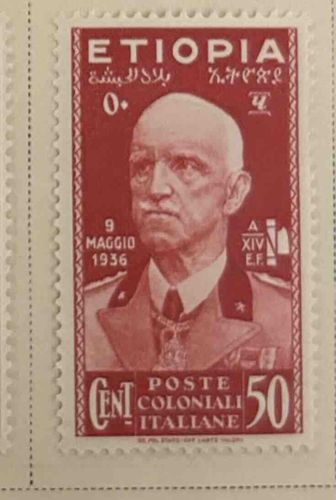
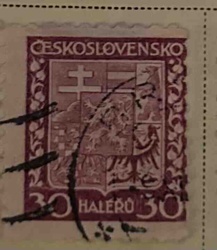
This item is a 50 Centesimi postage stamp issued during the Italian occupation of Ethiopia. The stamp predominantly features a portrait of a distinguished-looking man, likely a high-ranking Italian official or monarch, against a solid red background. The man is depicted in military attire, complete with epaulets, medals, and a neatly tied tie. His gaze is directed slightly to the left from the viewer's perspective, and he has a receding hairline. The overall color scheme is red and white, with white borders and text contrasting the red-hued image. Inscriptions are visible in multiple languages, including 'ETIOPIA' in Latin script at the top, along with what appears to be Amharic script below it, indicating the country of issue (or occupation). To the lower left of the portrait, '9 MAGGIO 1936' is printed, likely commemorating a significant date. On the lower right, 'A XIV E.F.' is present, which refers to the 14th year of the Fascist Era. The denomination '50' is clearly visible in the bottom right corner, alongside 'CENT' and 'POSTE COLONIALI ITALIANE' in the bottom left, signifying its value and issuer. The stamp exhibits classic perforation around its edges, characteristic of postal currency. The condition appears well-preserved, with no obvious tears, creases, or major discoloration visible in the provided image. The printing quality seems consistent, suggesting it was produced through standard philatelic methods of the era. The style is typical for official government issues of the mid-20th century, combining portraiture with textual information in a formal layout. The slight pixelation in the image makes it difficult to discern exact paper quality or watermarks, but the overall presentation is clean and sharp for its age.
AI Appraisal Report
This Ethiopia Italian Occupation 50 Centesimi stamp, depicting a monarch or official, appears to be in very good condition based on the provided image. I observe no obvious tears, significant creases, or discoloration that would drastically diminish its value. The perforations seem intact and well-separated. The print quality is sharp, consistent with standard philatelic production for the era, and the registration of the design elements appears sound. The presence of '9 MAGGIO 1936' and 'A XIV E.F.' dates it precisely to the Fascist era, which can be a point of historical interest. Authenticity, based solely on this image, seems probable. However, without physical examination, I cannot confirm the paper quality, detect potential repairs, thins, or hidden faults like toning or regumming. Similarly, watermarks, critical for definitive authentication for many stamps of this period, cannot be verified from an image.
Market conditions for Italian colonial issues, especially those related to the brief occupation of Ethiopia, tend to be stable with moderate demand among philatelic collectors specializing in colonial history or Italian issues. While not exceptionally rare, these stamps are not commonly found in pristine condition. Comparables would include other high-denomination stamps from this specific occupation period in similar condition. The historical context contributes to its appeal. To fully authenticate and confirm the condition without doubt, a physical inspection is essential to check for expert repairs, paper type verification, and watermark detection, none of which can be done from a photograph alone.