AI estimate as of October 9, 2025 · verify with a professional before acting
AI-Generated · Verify before acting
Everything on this page is generated by AI for informational purposes only. AI can make mistakes — the AI may misidentify items or misattribute them (artist, maker, brand, designer, origin, era). This is not an official valuation and should not be used for insurance, sale, tax, estate, legal, or lending purposes — or any decision requiring a certified appraisal. It is not an authoritative claim about any person, brand, or rights holder — do not share or rely on it as a factual statement about a third party. Always consult qualified professionals before making financial decisions.
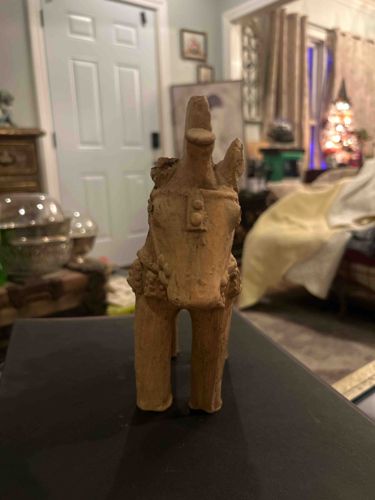
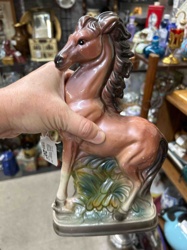
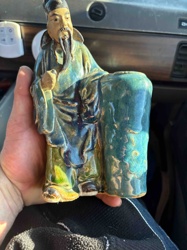
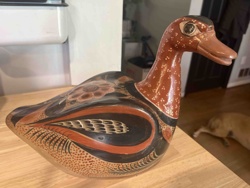
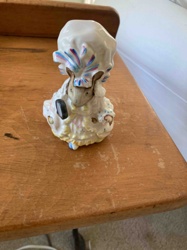
The item is a terracotta figurine depicting an equine creature, most likely a horse or donkey, presented in a stylized, standing posture. The primary material appears to be unglazed, coarse-grained terracotta clay, exhibiting a natural, unpainted reddish-brown to buff color typical of fired earthenware. The construction technique is likely hand-molded and fired. The figurine features a columnar body with four sturdy, un-articulated legs that taper slightly towards the base, suggesting a solid form rather than hollow construction. The head is elongated and somewhat abstract, with a prominent, almost beak-like snout and what appear to be rudimentary ears or a mane crest. There's a distinct decorative harness-like element or textile depicted around the animal's neck/chest area, characterized by a series of raised, circular details resembling buttons or studs down the front, and more textured, possibly braided or knotted elements on the sides. These textured details are rough and granular, suggesting a tactile representation of adornment. The tail is not clearly visible or may be absent/broken. The overall craftsmanship suggests a folk art or ancient artifact aesthetic, with robust and somewhat crude details rather than refined anatomical accuracy. There are no clear manufacturer's marks or signatures visible. The condition appears consistent with age, showing a dry, matte surface with potential areas of loss or chipping, particularly around the raised decorative elements and edges of the legs. The piece exhibits a weathered patina, indicating substantial age or exposure. The simplistic form and decorative elements are reminiscent of ancient or indigenous ceramic traditions from various cultures, such as pre-Columbian, ancient Mediterranean, or early Asian art. Its quality is characterized by its authenticity as a handcrafted object, emphasizing cultural or historical significance over artistic perfection.
AI Appraisal Report
Based on my visual examination of the provided image of this terracotta equine figurine, I assess its condition as consistent with antique or archaeologically recovered earthenware. The unglazed surface shows a dry, matte texture with evidence of weathering and surface abrasion, indicative of age and handling. There are no major breaks or repairs immediately apparent, though minor chipping is visible, particularly on the raised decorative elements and leg edges, which is typical for such an object.
Authenticity, based solely on visual cues, appears plausible for an ancient or folk art piece. The hand-molded construction, coarse terracotta, and stylized form are consistent with early ceramic traditions. However, definitive authentication without physical inspection is impossible. An in-person examination would allow me to assess the clay's precise composition, firing temperature, and construction marks. Microscopic analysis could reveal true age and manufacturing techniques. Provenance documentation, detailing the figurine's history of ownership and discovery, would be crucial for ultimate verification. Thermoluminescence (TL) dating would be the definitive scientific test for age.
Regarding market conditions, such pieces fall into the category of ancient art, ethnographic art, or folk art. Demand is moderate, driven by collectors interested in specific cultural periods or primitive art. Rarity is difficult to assess without knowing its origin; similar, albeit more refined, pieces from established cultures command higher prices. This specific piece, with its somewhat crude yet charming aesthetic, would likely appeal to a niche market. Its primary value driver is its apparent age and hand-crafted authenticity. The lack of specific cultural attribution or refined artistry somewhat limits its upper valuation compared to documented archaeological finds. Without provenance or scientific dating, it carries the risk of being a later revival or reproduction, which is a significant factor impacting value.