AI estimate as of September 23, 2025 · verify with a professional before acting
AI-Generated · Verify before acting
Everything on this page is generated by AI for informational purposes only. AI can make mistakes — the AI may misidentify items or misattribute them (artist, maker, brand, designer, origin, era). This is not an official valuation and should not be used for insurance, sale, tax, estate, legal, or lending purposes — or any decision requiring a certified appraisal. It is not an authoritative claim about any person, brand, or rights holder — do not share or rely on it as a factual statement about a third party. Always consult qualified professionals before making financial decisions.
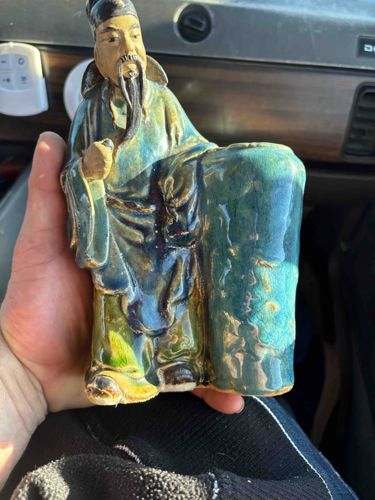
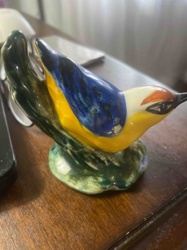
This is a glazed ceramic figurine depicting a seated male figure, likely a Chinese scholar or immortal (e.g., Lu Dongbin, one of the Eight Immortals, often depicted with a scroll or instrument). The figure is seated with one arm resting on a cylindrical object, possibly a scroll or a tea caddy/vase. The predominant colors of the glaze are various shades of turquoise, blue, green, and brown, creating a mottled, iridescent effect often seen in 'flambe' or 'oil spot' glazes, suggesting a certain firing technique. The face and hands are unglazed, revealing the natural clay body, which appears to be a light tan or buff color. The figure is adorned with a meticulously sculpted beard and mustache, painted black, and wears a traditional cap or headwear. His attire consists of robes with flowing drapery, characteristic of ancient Chinese garments. The base of the figurine, particularly where the feet are visible, shows some unglazed areas and minor wear, possibly small chips or rubs consistent with age and handling. The overall condition appears good with a rich patina developed over time. The craftsmanship suggests a hand-molded and hand-glazed piece, with attention to facial features and drapery folds, indicating a moderate to high level of detail for a ceramic figurine of this type. The vibrant, variegated glazes add to its aesthetic appeal. There are no clear manufacturer's marks or signatures visible in the provided image, but the style points towards a 20th-century Asian ceramic production, possibly mid-century, emulating earlier styles.
AI Appraisal Report
Upon visual examination of the provided images, this Chinese glazed ceramic figurine of a seated scholar or immortal presents as a decorative piece of good quality, likely produced in the mid-to-late 20th century. The figure exhibits a vibrant, mottled turquoise and blue 'flambe' style glaze, which is visually appealing. The unglazed face and hands, showing the buff-colored stoneware body, and the black-painted facial hair are characteristic of certain 20th-century Chinese export ceramics. The overall condition appears good, with minor wear and potential small chips on the base consistent with its age. While the craftsmanship shows a moderate level of detail in the drapery and facial modeling, the style and glazing technique are commonly found in the market, suggesting it is a decorative homage to earlier, more significant Tang or Ming dynasty sancai wares rather than a period antique.
The current market for such 20th-century decorative ceramics is stable but not exceptionally strong. Comparable figurines, often unmarked and identified as 'Shiwan' or 'Foshan' style ware, regularly sell at auction and online marketplaces in the $200 to $500 range. The value of this piece is primarily aesthetic rather than historical or rare.
A significant limitation of this appraisal is its reliance on images alone. I am unable to physically handle the piece to assess its weight, test the glaze, or examine the clay body under magnification. Full authentication would require a hands-on inspection to look for hidden marks, signs of modern tooling, or repair. Furthermore, documentation of provenance or thermoluminescence (TL) testing would be necessary to rule out greater age, though this is considered highly unlikely based on the visual evidence.