AI estimate as of July 7, 2025 · verify with a professional before acting
AI-Generated · Verify before acting
Everything on this page is generated by AI for informational purposes only. AI can make mistakes — the AI may misidentify items or misattribute them (artist, maker, brand, designer, origin, era). This is not an official valuation and should not be used for insurance, sale, tax, estate, legal, or lending purposes — or any decision requiring a certified appraisal. It is not an authoritative claim about any person, brand, or rights holder — do not share or rely on it as a factual statement about a third party. Always consult qualified professionals before making financial decisions.
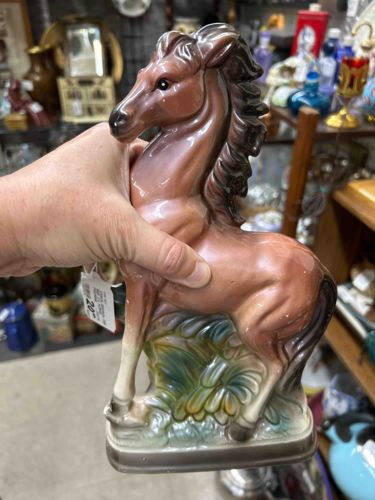
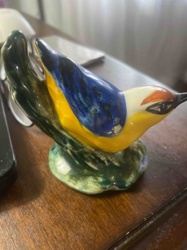
This item is a ceramic figurine depicting a horse, likely designed as a decorative piece or possibly a decanter given its shape. It features a rich, glossy glaze with a predominant reddish-brown hue for the horse's body, transitioning to lighter tones on its belly and legs, suggesting a naturalistic style with some artistic interpretation. The horse is depicted in a rearing or standing pose, with its head turned slightly and a flowing mane and tail in a dark brown or black color, providing contrast. The eyes are small and black, adding to the horse's lifelike appearance. It stands on a molded base simulating natural ground cover, painted in varying shades of green, yellow, and blue, suggesting foliage and perhaps water elements. The construction appears to be solid cast ceramic, indicating good craftsmanship. There are no immediately visible chips, cracks, or significant scuffs, suggesting good overall condition, though a full inspection would require handling. The glossy finish helps to reflect light, highlighting the contours of the horse's musculature and the texture of its mane. The underside of the base, though not fully visible, likely provides stability. No specific maker's marks or signatures are discernable from the image, but the style suggests a mid-20th century production, possibly from the 1950s or 1960s, a popular period for such ceramic animal figurines. The craftsmanship points to mass production but with attention to detail in the molding and painting.
AI Appraisal Report
Upon visual examination of the provided image, this ceramic horse figurine presents in very good condition. I observe no chips, cracks, or significant scuffs, and the glossy finish appears well-preserved, reflecting light consistently. The detailed molding and hand-painted elements, particularly the mane, tail, and base, suggest attention to craftsmanship typical of mid-20th century decorative ceramics. Its potential function as a decanter cannot be confirmed without physical inspection.
In terms of market conditions, ceramic animal figurines from the 1950s-1960s, while popular, are generally not rare. Demand is moderate, driven by collectors of vintage decorative arts and equestrian enthusiasts. Comparable sales for similar mass-produced ceramic horse figurines in excellent condition typically fall within a modest range. Factors impacting value include the lack of discernible maker's marks, which prevents attribution to a notable manufacturer or artist, and the commonality of the subject matter. While attractive, it doesn't appear to possess unique characteristics that would elevate its value significantly above the general market for such items.
Limitations in authenticity verification from an image are considerable. I cannot definitively confirm the material (ceramic vs. resin, though ceramic is strongly suggested), whether it's a decanter, or the presence of any hidden damage. For full authentication and a more precise valuation, I would require a physical in-hand examination to assess the exact material, internal condition, actual dimensions, weight, and to search for any impressed or painted marks on the underside of the base. Provenance documentation, though unlikely for an item of this type, would also add to its verifiable history.