AI estimate as of September 30, 2025 · verify with a professional before acting
AI-Generated · Verify before acting
Everything on this page is generated by AI for informational purposes only. AI can make mistakes — the AI may misidentify items or misattribute them (artist, maker, brand, designer, origin, era). This is not an official valuation and should not be used for insurance, sale, tax, estate, legal, or lending purposes — or any decision requiring a certified appraisal. It is not an authoritative claim about any person, brand, or rights holder — do not share or rely on it as a factual statement about a third party. Always consult qualified professionals before making financial decisions.
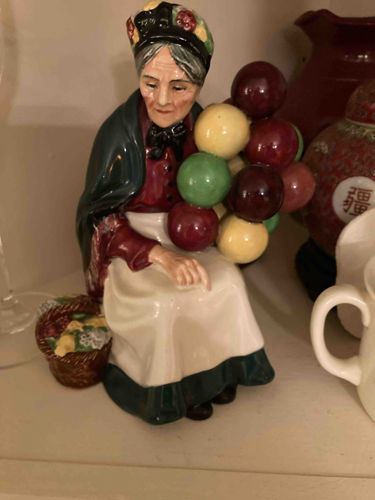
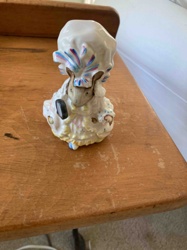
This is a ceramic figurine depicting an elderly woman seated, holding a cluster of colorful, spherical objects that resemble either balloons or fruit, possibly apples or gumballs. The figurine appears to be made of glazed ceramic or porcelain, exhibiting a smooth, reflective surface. The woman is dressed in traditional attire, featuring a dark green shawl or cape draped over a reddish-brown garment. She wears a white apron over a lighter-colored skirt, which has a dark green trim at the bottom. Her head is covered with a dark bonnet adorned with floral designs in red and green, and white flowers. Her hair, visible beneath the bonnet, is depicted as grey. The facial features are finely detailed, showing signs of aging such as wrinkles around the eyes and mouth, conveying a sense of character and experience. The spherical objects she holds are in shades of dark red/maroon, yellow, and green, organized in a bunch, with her right hand seemingly supporting them from underneath, while her left hand rests on her lap. To her left, at her side, there is a small brown basket filled with what appears to be flowers or small fruits, hinting at a vendor or market scene. The overall style suggests a mid-20th century European folk art or commemorative figurine. There are no visible chips, cracks, or significant damage, suggesting it is in good collectible condition, though minor wear consistent with its age might be present upon closer inspection. The craftsmanship appears to be of decent quality, with careful hand-painting evident in the details of her clothing, face, and the small basket.
AI Appraisal Report
Based on my visual examination of the provided image, this ceramic figurine of an old woman holding what appear to be balloons or fruit is in good collectible condition. I observe no obvious chips, cracks, or significant damage, suggesting well-preserved integrity for its age. The glazed ceramic or porcelain finish appears smooth and reflective. The presence of traditional attire, finely detailed features, and the small basket suggest a mid-20th century European folk art aesthetic. The craftsmanship seems decent, with careful hand-painting evident.
Market conditions for such decorative ceramic figurines are generally stable but not exceptionally strong for pieces without a known maker or particularly rare design. Comparables in the secondary market, including those found on online auction sites and antique dealer portals, typically fall within a modest range. Demand is moderate, primarily from collectors of vintage European decorative arts, character figurines, or those seeking nostalgic items. While not exceedingly rare, its good condition and endearing subject add to its appeal.
Factors significantly impacting value include its condition, the level of detail, and perceived age. Without a manufacturer's mark or artist signature, its value is mainly decorative. The lack of visible damage is a strong positive. However, it is important to note the limitations of authenticity verification from images alone. An in-person examination would be crucial to confirm the absence of hairline cracks, repairs, or subtle glaze imperfections that are not visible in the photograph. Furthermore, physical inspection would allow for identification of any maker's marks or signatures on the base, which could significantly alter its appraisal value. Provenance documentation or scientific testing (e.g., thermoluminescence dating) would be needed for full authentication of its age and origin.