AI Appraisal Estimate

AI-generated estimates · not official valuations

From the user

What was submitted

Photo and notes provided by the user — not generated by AI

Submitted item photo
Submitted photo · June 12, 2026

User's notes

No additional notes provided.

AI analysis below

AI appraisal

AI analysis & estimate

AI-Generated · Verify before acting

Everything below is generated by AI for informational purposes only. AI can make mistakes — the AI may misidentify items or misattribute them (artist, maker, brand, designer, origin, era). This is not an official valuation and should not be used for insurance, sale, tax, estate, legal, or lending purposes — or any decision requiring a certified appraisal. It is not an authoritative claim about any person, brand, or rights holder — do not share or rely on it as a factual statement about a third party. Always consult qualified professionals before making financial decisions.

Read the full disclaimer

AI Identification

·Not independently authenticated·Verify before acting

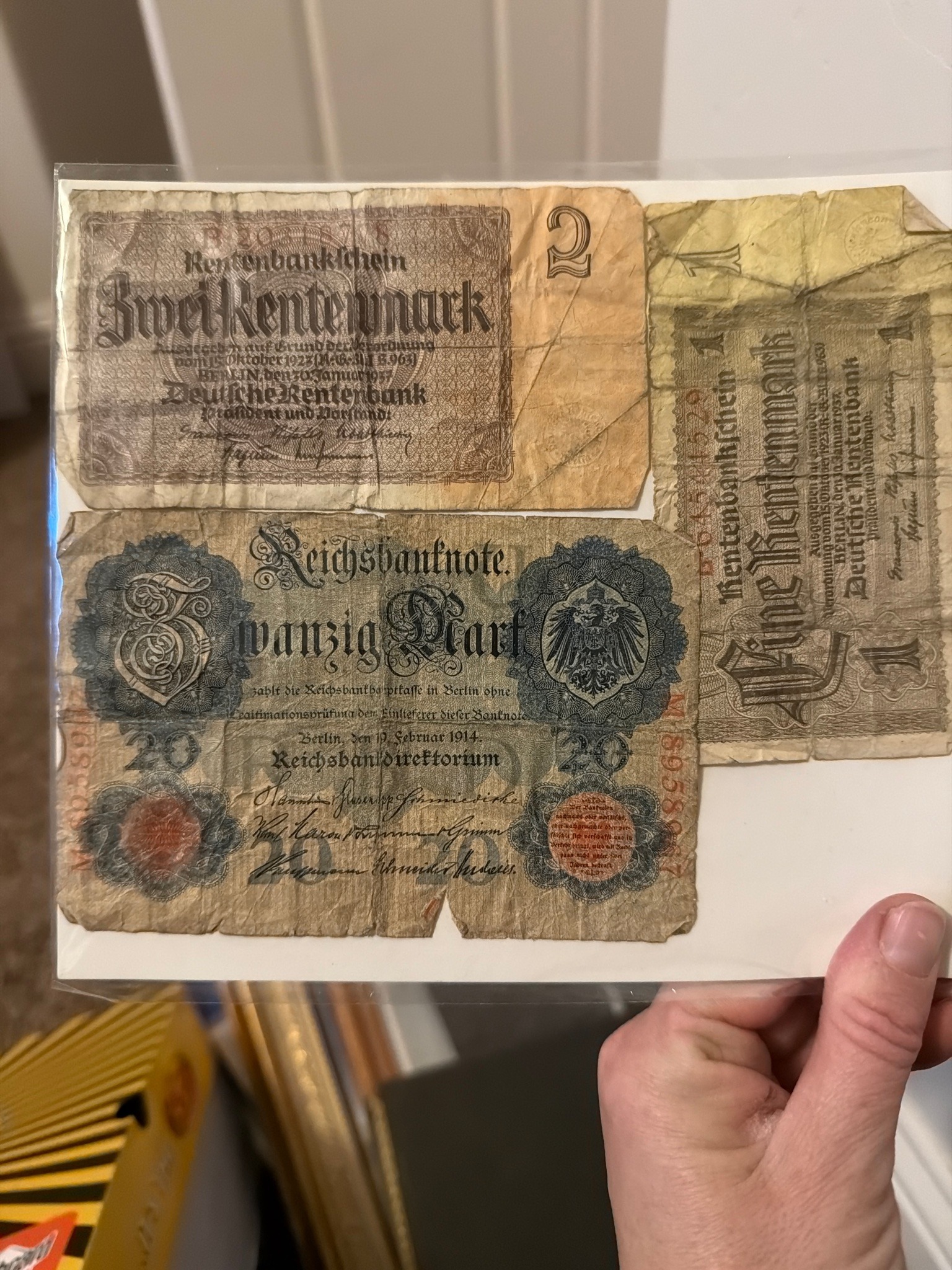
Collection of German Banknotes: 20 Mark (1914), 2 Rentenmark (1937), and 1 Rentenmark (1937)

Numismatics / Historical Paper Currency

AI Estimated Value

·Not an official valuation·Verify before acting

$10.00 - $18.00

As of June 12, 2026

AI Item Analysis

·AI can make mistakes·Verify before acting
This is a grouping of three historical German banknotes presented in a clear protective sleeve. The primary note is a 20 Reichsbanknote dated February 19, 1914, featuring blue and greenish-grey ornate intaglio printing with brown-red serial numbers and seals. It displays heavy circulation wear, including significant edge fraying, tears at the bottom margin, deep vertical and horizontal folds, and general discoloration/soiling common for WWI-era paper currency. The second note is a 2 Rentenmark (Zwei Rentenmark) issued by the Deutsche Rentenbank, dated January 30, 1937. It features brown printing on a cream/tan paper background with a large '2' in the top right corner. The third note, oriented vertically, is a 1 Rentenmark (Eine Rentenmark) from the same 1937 series. Both Rentenmark notes show heavy creasing, soft corners, and significant yellowing/toning. All three notes exhibit Fraktur typeface and signatures from bank officials. The condition across all pieces is 'Fair' to 'Good' (VG) at best, given the visible structural damage, staining, and extreme handling wear. These represent transition periods in German monetary history, from the late Imperial era into the pre-WWII period.

AI Appraisal Report

·AI can make mistakes·Verify before acting
I have examined the digital representation of this three-note grouping, consisting of a 1914 20 Mark Reichsbanknote and two 1937 Rentenmark notes (1 and 2 denominations). Upon visual inspection, the condition of these specimens is graded as 'Good' to 'Very Good' (VG 8-10) due to significant circulation distress. The 1914 note exhibits heavy marginal tearing and deep cross-folding, while the 1937 issues show severe yellowing and corner softening. Authenticity appears consistent with circulating currency of the era, notably the characteristic Fraktur typography and intaglio-printed under-patterns. From a market perspective, these notes were issued in massive quantities. The 1914 20 Mark note was printed in the hundreds of millions as Germany moved toward a war economy, and the 1937 Rentenmarks were common denominations of the pre-WWII period. Because collectors prioritize 'Uncirculated' (UNC) condition for these common issues, heavily circulated examples such as these hold nominal value, primarily as historical curiosities rather than investment-grade numismatic assets. Similar groupings frequently sell at auction or through private dealers in the $3–$6 range per note. Please note that this appraisal is based on photographic evidence only. A full authentication would require an in-person physical inspection to verify paper thickness, watermark clarity, and the 'feel' of the intaglio ink. I would also check for the presence of microscopic security fibers and perform a UV light test to ensure no modern chemical cleaning or repair has been attempted. For definitive valuation, professional grading by a third party like PMG (Paper Money Guaranty) would be required, though the cost of such service would likely exceed the fair market value of these specific items.

Get your items appraised

Instant estimates of your treasures with AI-powered appraisals

Browse More Appraisals