AI Appraisal Estimate

AI-generated estimates · not official valuations

From the user

What was submitted

Photo and notes provided by the user — not generated by AI

Submitted item photo
Submitted photo · May 25, 2026

User's notes

No additional notes provided.

AI analysis below

AI appraisal

AI analysis & estimate

AI-Generated · Verify before acting

Everything below is generated by AI for informational purposes only. AI can make mistakes — the AI may misidentify items or misattribute them (artist, maker, brand, designer, origin, era). This is not an official valuation and should not be used for insurance, sale, tax, estate, legal, or lending purposes — or any decision requiring a certified appraisal. It is not an authoritative claim about any person, brand, or rights holder — do not share or rely on it as a factual statement about a third party. Always consult qualified professionals before making financial decisions.

Read the full disclaimer

AI Identification

·Not independently authenticated·Verify before acting

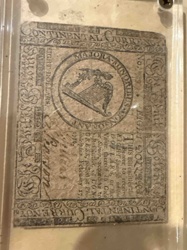
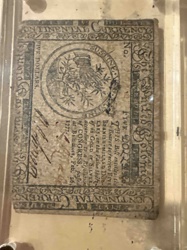
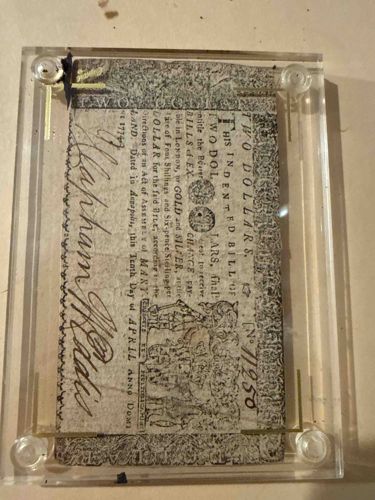
1774 Maryland Revolutionary War Period Two Dollar Indented Bill

Historical Currency and Numismatics

AI Estimated Value

·Not an official valuation·Verify before acting

$450 - $650

As of May 25, 2026

AI Item Analysis

·AI can make mistakes·Verify before acting
This is an original Colonial-era fiscal document representing a 'Two Dollars' indented bill issued by the Province of Maryland. The note is dated April 10, 1774, placing it just before the formal start of the American Revolutionary War. It features a vertical orientation printed on thick, heavy-gauge handmade paper, typical of 18th-century rag paper. The primary text describes it as a 'Bill of Exchange' payable in gold or silver at the rate of four shillings and sixpence sterling per dollar. It includes a unique serial number, 11250, handwritten in ink. A prominent feature is the elaborate decorative border and the inclusion of the 'Lord Baltimore' armorial crest of Maryland at the bottom. The note bears a bold, authentic handwritten signature in iron gall ink, likely belonging to one of the authorized commissioners. Condition-wise, the paper has aged to a brownish-tan patina with visible foxing and vertical creasing from historical folding. The edges appear rough, which is consistent with the 'indented' nature of these bills where they were cut from a stub to prevent counterfeiting. It is currently preserved in a modern lucite or acrylic screw-down display frame. These notes were printed by Anne Catharine Green and Son in Annapolis, Maryland, and represent a crucial piece of early American monetary history.
AI Appraisal Report

·AI can make mistakes·Verify before acting
Based on my visual examination of this Two Dollar Maryland indenture dated April 10, 1774, I have assessed this piece as an original Colonial issue. The visual markers are consistent with authentic bills printed by Anne Catharine Green and Son in Annapolis. The distinctive typeface, the specific 'Lord Baltimore' crest, and the iron gall ink oxidation on the signature and serial number (#11250) align with known examples from this series. The condition is generally fine to very fine for the period; the paper shows expected aging and distinct foxing, along with a central vertical fold typical of circulation. The margins are relatively tight but preserve the crucial indented top edge that served as the primary anti-counterfeiting measure of the era. The market for Maryland colonial currency remains robust, particularly for pre-Revolutionary notes issued during the pivotal 1774 period. While not as rare as the 1770 issues, the 1774 series is highly collectible. Comparable sales for notes in this 'Fine' condition usually land in the mid-hundreds range. Value is slightly suppressed by the heavy foxing and staining compared to pristine examples which can fetch upwards of $800. It is important to note that this appraisal is based solely on digital imagery. While the visual evidence strongly suggests authenticity, I cannot definitively confirm the paper's texture or watermarks without physical handling. I recommend removing the item from the screw-down holder for long-term preservation, as these can flatten historical paper fibers. Definitive authentication would require tactile examination of the rag paper and microscopic verification of the ink flow.

Get your items appraised

Instant estimates of your treasures with AI-powered appraisals

Browse More Appraisals