These notes were written by the person who submitted this item. Appraiser.AI has not verified them, and the AI's identification and estimate may rely on them.
AI Estimated Value
Not an official valuation
$300-600
AI estimate as of September 16, 2025 · verify with a professional before acting
AI-Generated · Verify before acting
Everything on this page is generated by AI for informational purposes only. AI can make mistakes — the AI may misidentify items or misattribute them (artist, maker, brand, designer, origin, era). This is not an official valuation and should not be used for insurance, sale, tax, estate, legal, or lending purposes — or any decision requiring a certified appraisal. It is not an authoritative claim about any person, brand, or rights holder — do not share or rely on it as a factual statement about a third party. Always consult qualified professionals before making financial decisions.
This analysis also relies on unverified notes provided by the user, which may be incomplete or inaccurate and could affect the result.
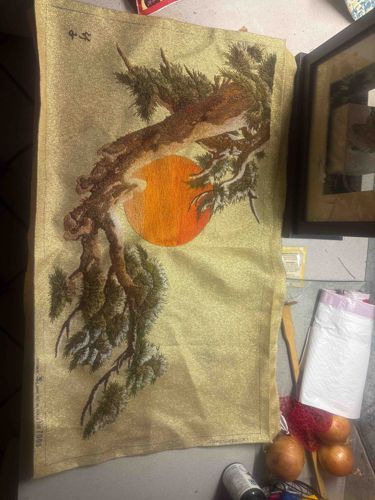
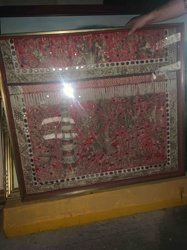
This item is an embroidered tapestry depicting a gnarled pine branch against a setting or rising sun on a golden background. The tapestry appears to be rectangular, though its exact dimensions are not clear from the image; it seems to be of a size suitable for wall hanging. The primary material is likely a textile, possibly silk or a synthetic blend, given the slight sheen observed on the golden background. The background fabric itself has a textured finish, possibly a subtle brocade or a weave that creates a shimmering effect, in shades of light gold or beige. The embroidery is executed with various thread colors: rich browns for the tree trunk, dark greens and lighter greens/white for the pine needles, and vibrant oranges and yellows for the sun. The sun is depicted as a solid, circular form, fully embroidered, creating a focal point with its warm hue. The pine branch is rendered with considerable detail, showing its rough texture and the individual clusters of needles. There are some faint, possibly embroidered or printed, calligraphic characters in the upper left corner, suggesting an East Asian origin, though these are not clearly legible. Another small, illegible mark or signature appears along the left edge, near the bottom. The edges of the tapestry show evidence of hemming, indicating a finished piece. There are no obvious signs of significant damage like tears or major stains, but the fabric does exhibit some creases and folds, suggesting it may have been stored or handled without being stretched. The overall craftsmanship appears to be of good quality, with dense stitching creating a distinct and tactile image. The style is distinctly Asian, likely Japanese or Chinese, given the subject matter of pine and sun, which often carry symbolic meaning (longevity, rejuvenation). The estimated age is difficult to determine without more information, but the lack of significant fading or wear suggests it is not ancient, possibly mid-20th century to contemporary.
AI Appraisal Report
I have examined the provided image of the 'Embroidered Pine and Sun Tapestry' submitted by Matsurato. The textile depicts a gnarled pine branch against a golden background with a prominent sun, executed with dense embroidery. The craftsmanship appears good, with rich colors and detailed needlework for the pine and sun. The general condition, based on the image, seems good, with no obvious major damage, tears, or significant stains. However, I note some creases, which are common and not severely detrimental to value but suggest storage or handling without proper stretching.
Authenticity, style, and origin are strongly East Asian, likely Japanese or Chinese, given the symbolic subject matter of pine (longevity) and sun (rejuvenation). The faint calligraphic characters and a possible signature further support this. However, without clear images of these marks, definitive attribution or translation is impossible. Market conditions for contemporary or mid-20th century embroidered textile art, particularly Asian pieces, can vary widely. While the quality appears good, this specific style may appeal to a niche market. Comparables for well-executed decorative tapestries of this potential age and origin typically range in the hundreds of dollars, depending significantly on artist attribution, precise age, and materials.
Factors impacting value include the clear execution of the embroidery and the symbolic imagery. Limitations in authenticity verification from images alone are significant. For full authentication and a more precise valuation, I would require in-person examination to assess the fiber content, embroidery techniques, and overall material quality. Clear photographs of the calligraphic marks and signature, or documentation of provenance, would be crucial for artist identification and more accurate dating. Scientific testing could confirm fiber types and dye stability, though this is often reserved for higher-value pieces. Based on what is visible, this is a decorative and competently made piece.