AI estimate as of October 2, 2025 · verify with a professional before acting
AI-Generated · Verify before acting
Everything on this page is generated by AI for informational purposes only. AI can make mistakes — the AI may misidentify items or misattribute them (artist, maker, brand, designer, origin, era). This is not an official valuation and should not be used for insurance, sale, tax, estate, legal, or lending purposes — or any decision requiring a certified appraisal. It is not an authoritative claim about any person, brand, or rights holder — do not share or rely on it as a factual statement about a third party. Always consult qualified professionals before making financial decisions.
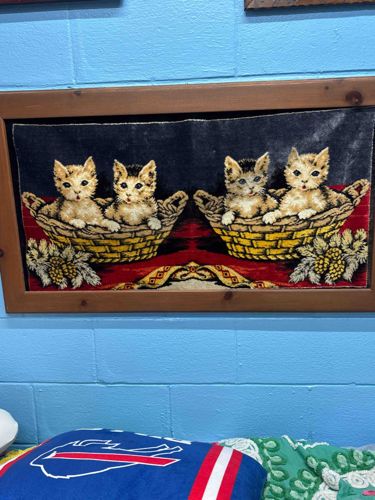
This item is a framed woven tapestry, likely machine-made, featuring a charming symmetrical design of four kittens seated in two woven baskets. The tapestry is characterized by its deep, rich colors: a dominant dark blue background, vibrant yellow baskets, and a striking red base pattern. Each basket holds two kittens, depicted with light tan and brown fur, distinctive pointy ears, and expressive eyes. Below each basket, a stylized floral or fruit arrangement, possibly pinecones or thistles in muted whites and yellows, adds to the decorative appeal. The overall composition suggests a folk art or rustic aesthetic. The tapestry itself appears to be of a medium pile, possibly velvet or a similar soft woven material, which gives the figures a slightly raised, textured quality. It is encased within a simple, light brown wooden frame with a visible grain, suggesting a natural wood finish, possibly oak or pine. The frame appears to be in good condition with no obvious chips or cracks. The tapestry itself shows some signs of gentle wear consistent with its age, such as slight blurring of details in some areas and potential dust accumulation on the darker background. There are no visible maker's marks, signatures, or stamps evident in the provided image. Given its style and construction, it likely dates from the mid to late 20th century, possibly 1960s-1980s. The repetitive, mirrored design is a common feature in decorative textiles of that period. Its primary function is decorative, intended to add warmth and a touch of kitsch to an interior space. The craftsmanship appears to be commercially produced, with a focus on visual appeal over intricate hand-woven detail.
AI Appraisal Report
Based on my visual examination of the provided image, this framed woven tapestry, featuring four kittens in baskets, appears to be a machine-made decorative piece. The vivid colors—dark blue, yellow, and red—and the symmetrical, mirrored design are consistent with mass-produced textiles from the mid to late 20th century, likely the 1960s-1980s. The 'medium pile' surface suggests it could be a velvet or similar woven material, common for decorative wall hangings of that era. The simple, light brown wooden frame with visible grain appears to be in good condition, without obvious damage. The tapestry itself shows signs of gentle wear, such as slight blurring of details and potential dust accumulation, which is typical for an item of its age. There are no visible maker's marks or signatures, which further supports its commercial origin rather than being a unique, artisan piece.
From a market perspective, decorative tapestries of this nature fall into the 'kitsch' or vintage home decor category. Demand is generally low unless it resonates strongly with a specific nostalgic aesthetic or a collector interested in novelty cat-themed items. Rarity is not a factor here, as similar mass-produced items were common. Prices for comparable framed machine-woven tapestries on secondary markets (e.g., online marketplaces, estate sales) typically range from $30 to $100 depending on size, condition, and specific aesthetic appeal. The primary value drivers are its decorative charm and condition, rather than intrinsic artistic or material value. Factors impacting value negatively include its mass-produced nature and the current market's generally low demand for such items.
It is crucial to note that this authenticity assessment is limited to visual examination of images. A physical inspection would allow me to thoroughly assess the textile's fiber content, construction method (machine vs. hand-woven verification), and internal condition of the frame and tapestry. In-person examination would also confirm the absence of any hidden maker's marks, while provenance documentation (if available) could provide a more precise history and origin. Scientific testing is not typically applied to items of this type unless there were questions regarding specific material composition.