AI estimate as of December 3, 2025 · verify with a professional before acting
AI-Generated · Verify before acting
Everything on this page is generated by AI for informational purposes only. AI can make mistakes — the AI may misidentify items or misattribute them (artist, maker, brand, designer, origin, era). This is not an official valuation and should not be used for insurance, sale, tax, estate, legal, or lending purposes — or any decision requiring a certified appraisal. It is not an authoritative claim about any person, brand, or rights holder — do not share or rely on it as a factual statement about a third party. Always consult qualified professionals before making financial decisions.
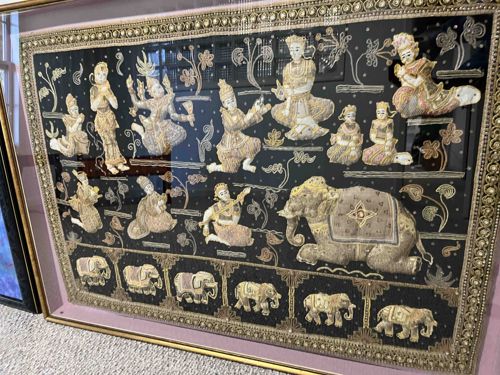
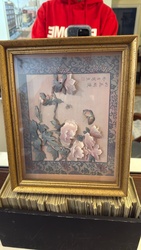
This is a framed Burmese tapestry, commonly known as a Kalaga, characterized by its intricate three-dimensional appliqué and embroidery work. The tapestry is presented under glass within a gold-colored frame, which has a matte gold finish and a slightly ornate appearance, suggesting a decorative framing style. The main fabric ground is a dark, possibly black or very dark blue, textile, which provides a stark contrast to the metallic threads and raised elements. The composition features a central tableau of numerous figures, likely deities or courtly characters, rendered in various poses, including standing, kneeling, and reclining. These figures are heavily embellished with gold and silver metallic threads, sequins, and possibly small beads, giving them a rich, textural quality and dimensionality. Some figures appear to have areas of pale pink or blush coloring, suggesting the use of colored threads or fabrics in addition to the metallic elements. Below the main scene, a large, ornate elephant is depicted, covered with an embellished blanket featuring geometric patterns, also executed in metallic threads and sequins. Further below, a border of smaller elephants walking in a processional manner is visible, each individually embroidered and appliquéd. The entire piece is bordered by a continuous band of intricate metallic embroidery and sequin work, creating a frame within the textile itself. The craftsmanship appears to be of high quality, with fine stitching and detailed embellishments. There are no obvious signs of significant damage to the textile itself visible through the glass, though minor wear consistent with age might be present. The reflectivity of the glass makes a full assessment of its condition challenging without direct inspection. The style is distinctly Southeast Asian, specifically Burmese, and such Kalagas are known for their traditional narrative scenes, often depicting religious or epic tales.
AI Appraisal Report
This framed Burmese Kalaga tapestry presents as a remarkable example of traditional textile art. Based on my visual examination, the condition appears very good, with no obvious signs of significant tearing, discoloration, or loss of metallic elements visible through the glass. The three-dimensional appliqué and intricate embroidery, characteristic of Kalagas, are well-preserved, showcasing fine craftsmanship. The elaborate central scene, bordered elements, and elephant motifs are consistent with authentic Burmese Kalaga designs, often depicting Jataka tales or courtly life. The gold-colored frame, while decorative, is a contemporary addition and its quality contributes marginally to the overall presentation.
Market conditions for Kalaga tapestries are generally stable. Similar framed examples with intricate scenes and good preservation typically sell in the mid to high hundreds, depending on size, complexity, and age. While not exceedingly rare, high-quality, well-preserved pieces like this, especially framed, are consistently sought after by collectors of Southeast Asian art and textiles. The detailed metallic work and textural depth enhance its appeal and value.
Limitations regarding authenticity verification from images alone are significant. I cannot definitively assess the age, specific materials used, or the nature of any repairs without direct physical inspection. An in-person examination would allow for a detailed assessment of the textile's fiber content, the condition of the metallic threads and sequins, and the backing fabric. Provenance documentation, detailing its history of ownership and origin, would further substantiate its authenticity and potentially its value. Scientific testing, such as elemental analysis of metallic threads, could provide definitive insights into its age and composition, confirming its traditional origins versus a more modern reproduction.