AI estimate as of October 31, 2025 · verify with a professional before acting
AI-Generated · Verify before acting
Everything on this page is generated by AI for informational purposes only. AI can make mistakes — the AI may misidentify items or misattribute them (artist, maker, brand, designer, origin, era). This is not an official valuation and should not be used for insurance, sale, tax, estate, legal, or lending purposes — or any decision requiring a certified appraisal. It is not an authoritative claim about any person, brand, or rights holder — do not share or rely on it as a factual statement about a third party. Always consult qualified professionals before making financial decisions.
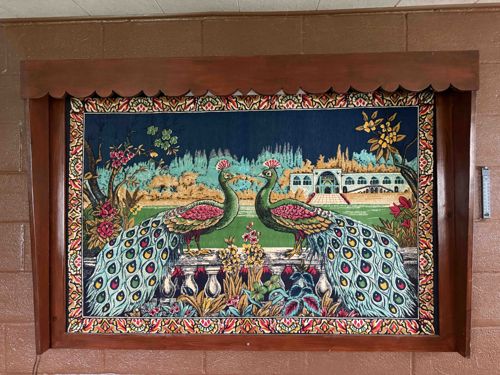
This item is a framed tapestry, likely made from woven textile materials such as wool or a synthetic blend, featuring a vibrant and detailed scenic depiction. The central image portrays two peacocks, richly colored in shades of green, blue, pink, and yellow, standing on an ornate balustrade or stone barrier. Their elaborate tail feathers are spread, displaying prominent 'eyes' in multiple colors. The background of the tapestry features a lush landscape with stylized trees and foliage, predominantly in lighter greens and yellows, and a grand, multi-arched building, possibly a palace or estate, indicating a classical or Middle Eastern architectural influence. The sky is a deep, rich blue. The tapestry itself is bordered by an elaborate floral and geometric pattern in reds, blues, golds, and creams, which serves to frame the central scene. The tapestry is enclosed within a solid dark wood frame. The frame has a simple, straight profile on the sides and bottom, and a distinctive decorative element at the top: a scalloped pediment or valance with alternating curvilinear cuts. This scalloped detail adds a touch of traditional or ornate styling to the overall piece. While precise dimensions are not provided, it appears to be a substantial wall hanging. The condition appears to be relatively good, with no obvious major tears or discolorations visible in the tapestry from the provided image. The colors remain vivid. The frame also appears sturdy, with a polished finish and no discernible damage. The style suggests it could be from the mid-20th century to more contemporary, possibly evoking designs inspired by Persian or European tapestry traditions. The craftsmanship of the tapestry, particularly the intricate detailing of the peacocks and the background, suggests a good quality textile art piece intended for decorative display.
AI Appraisal Report
Based on my visual examination of the provided image, this framed tapestry with a peacock scene appears to be in relatively good condition. The colors are vivid, and I don't observe any overt signs of major tears, fraying, or significant discoloration in the textile itself. The dark wood frame also appears sturdy with a polished finish and no visible damage. The scalloped pediment at the top adds a decorative flair, suggesting a traditional or ornate aesthetic. Authenticity, based solely on an image, is difficult to definitively confirm. While the intricate detailing of the peacocks and background suggests good craftsmanship, I cannot verify the type of fiber used (e.g., wool vs. synthetic blend) or the method of weaving without a physical inspection. These factors significantly impact value. The style, evoking Persian or European tapestry traditions, suggests it could be mid-20th century to contemporary. Without provenance documentation or a physical examination to ascertain material composition, age, and origin (e.g., hand-loomed vs. machine-made), I must state that this appraisal has limitations. Market conditions for decorative textile art, particularly framed tapestries of this apparent scale and aesthetic, are generally stable for pieces in good condition. Comparables typically sell within a few hundred dollars, with higher values reserved for authenticated antique or hand-woven pieces by known artisans, or those made from premium materials like pure silk or fine wool. Demand for decorative wall hangings of this nature is moderate, appealing to those seeking traditional or ornate decor. Rarity is not a significant factor here, as similar decorative tapestries are widely available. Key factors impacting value are the unknown material composition, true age, and manufacturing method (machine vs. hand-woven). Without a close-up physical examination, fiber testing, and a review of any existing documentation, I cannot precisely determine these crucial elements. My value range therefore reflects its current decorative appeal and good visual condition, acknowledging these limitations in authenticating its material and age.