AI Appraisal Estimate

AI-generated estimates · not official valuations

From the user

What was submitted

Photo and notes provided by the user — not generated by AI

Submitted item photo
Submitted photo · June 6, 2026

User's notes

No additional notes provided.

AI analysis below

AI appraisal

AI analysis & estimate

AI-Generated · Verify before acting

Everything below is generated by AI for informational purposes only. AI can make mistakes — the AI may misidentify items or misattribute them (artist, maker, brand, designer, origin, era). This is not an official valuation and should not be used for insurance, sale, tax, estate, legal, or lending purposes — or any decision requiring a certified appraisal. It is not an authoritative claim about any person, brand, or rights holder — do not share or rely on it as a factual statement about a third party. Always consult qualified professionals before making financial decisions.

Read the full disclaimer

AI Identification

·Not independently authenticated·Verify before acting

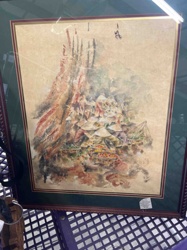
Traditional Balinese Ubud-Style Painting on Fabric

Fine Art / Southeast Asian Antiques

AI Estimated Value

·Not an official valuation·Verify before acting

$400 - $700

As of June 6, 2026

AI Item Analysis

·AI can make mistakes·Verify before acting
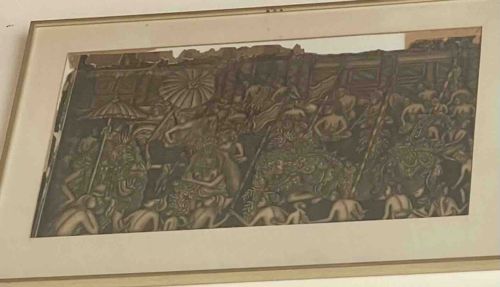
This item is an original Balinese painting, likely executed in the celebrated Ubud or Batuan style. The work is a horizontal composition featuring a dense, multi-figured narrative characteristic of Indonesian mythological or daily life scenes. The medium appears to be ink and tempera or acrylic on a traditional textile base. The color palette is composed of muted earth tones, greens, and ochres, reflecting a mid-20th-century aesthetic frequently found in works from the 1940s to the 1970s. Key features include traditional umbrellas (pajeng), highly stylized human figures with elongated forms, and intricate floral and architectural motifs that fill nearly every inch of the 'horror vacui' composition. The craftsmanship displays fine linework and delicate shading. Regarding condition, the artwork shows significant signs of age and environmental stress; the top edge of the textile has suffered jagged losses and fraying, suggesting it may have been torn from a previous mounting or affected by moisture and pests. The surface shows a general darkening or patina consistent with its age. It is housed in a simple, thin wooden frame with a wide cream mat, which shows some light staining and may not be archival. No maker's signature is immediately visible in the provided image, but such works were often signed on the lower right or reverse by local village masters.
AI Appraisal Report

·AI can make mistakes·Verify before acting
I have conducted a visual appraisal of this Balinese narrative painting, executed in the classic Ubud-style 'horror vacui' tradition. The work exhibits the fine linework and earthen pigment palette characteristic of the mid-20th-century period (circa 1950s-1970s). The composition, depicting a dense mythological or courtly scene, demonstrates high technical proficiency in the stylized anatomy and foliage detail. However, the condition significantly impacts the valuation. My examination reveals jagged losses, fraying, and environmental degradation along the upper textile margin, likely due to past moisture exposure or mechanical stress during a previous removal. The visible patina is consistent with aged organic dyes on cotton. The current framing appears non-archival, which poses a long-term risk of acid migration. While the market for Balinese art remains steady among specialized collectors of Southeast Asian antiquities, the lack of a visible signature and the present state of the fabric relegate this piece to the 'decorative vintage' tier rather than the 'investment-grade masterpiece' category. Authenticity as a period-correct piece appears likely based on the stylistic execution, but I must note that high-quality modern reproductions can mimic these aging characteristics. For a definitive authentication, an in-person examination is required to inspect the weave of the textile base and the specific binding agents used in the pigments. Provenance documentation or a signature discovery on the reverse would potentially increase the valuation by $500 or more if linked to a known master of the Pita Maha collective.

Get your items appraised

Instant estimates of your treasures with AI-powered appraisals

Browse More Appraisals