Southeast Asian Carved Wood Buddha Head
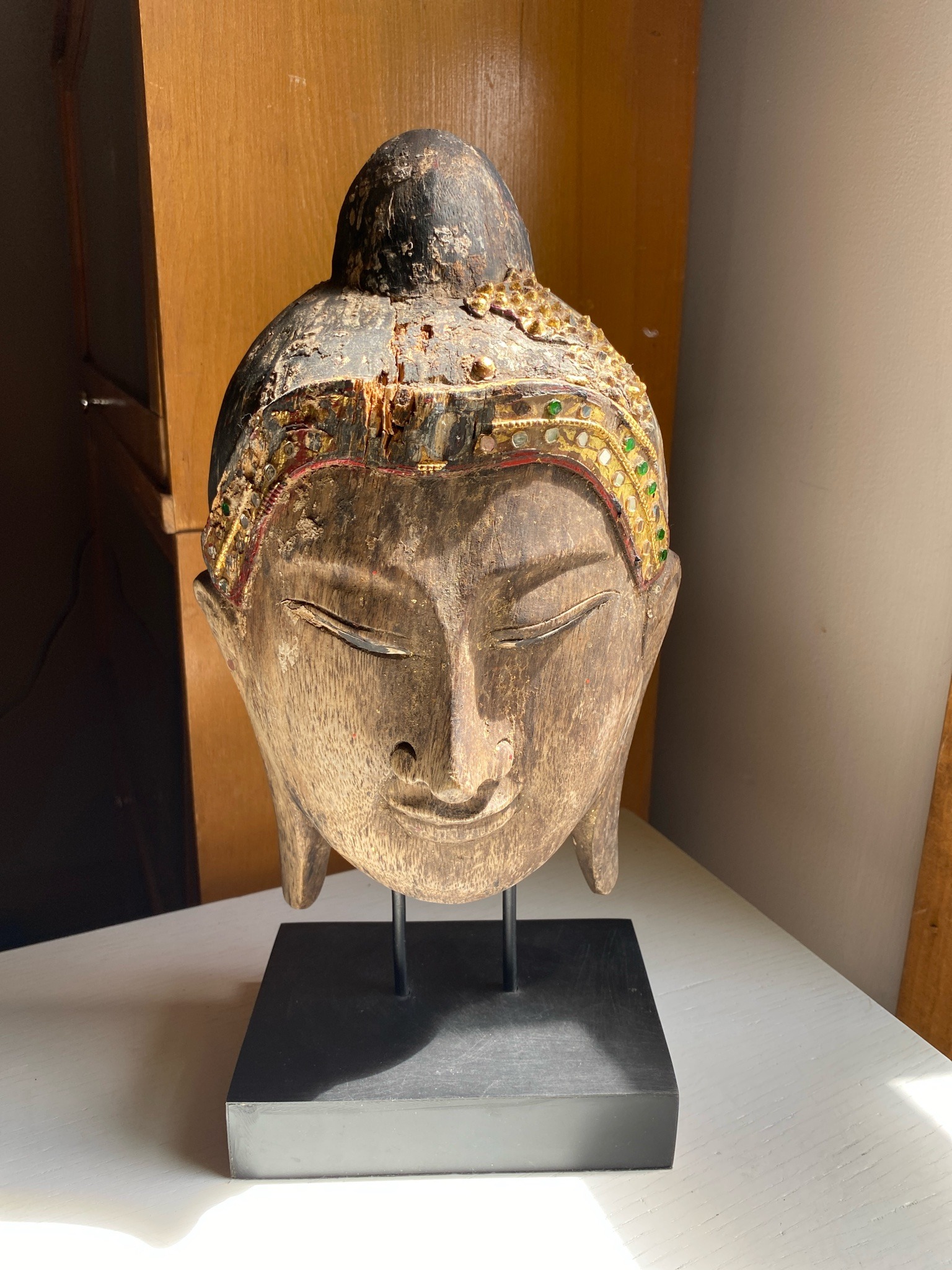
This is a hand-carved wooden head of a Buddha, likely originating from Southeast Asia, specifically in the Burmese (Mandalay or Shan) or Thai style. The sculpture is rendered with a serene expression, featuring downcast eyes, long earlobes, and a prominent ushnisha (cranial bump). The wood displays a heavy grain texture and a natural brown patina with remnants of black lacquer or charring on the upper portion. A notable feature is the ornate headband or crown, decorated with gold leaf gilding and 'thayo' (lacquer paste) relief work, embedded with multi-colored glass jewels in green, red, and clear tones. The piece shows significant signs of age and wear, including deep vertical cracks in the wood (checks) on the forehead and crown, some loss of the decorative glass inlay, and chipped lacquer. The face exhibits smooth transitions and subtle modeling, indicative of skilled craftsmanship. Based on the style and weathering, it is likely a mid-20th-century decorative piece or an older late 19th/early 20th-century religious fragment. It is presented on a modern black museum-style metal stand with a rectangular base.
AI-Generated Appraisal Disclaimer
Estimated Value
$450 - $700
Basic Information
Category
Asian Art and Antiques
Appraised On
April 30, 2026
Estimated Value
$450 - $700
Additional Details Provided By Owner
User Provided Information
Wood
Item Description
This is a hand-carved wooden head of a Buddha, likely originating from Southeast Asia, specifically in the Burmese (Mandalay or Shan) or Thai style. The sculpture is rendered with a serene expression, featuring downcast eyes, long earlobes, and a prominent ushnisha (cranial bump). The wood displays a heavy grain texture and a natural brown patina with remnants of black lacquer or charring on the upper portion. A notable feature is the ornate headband or crown, decorated with gold leaf gilding and 'thayo' (lacquer paste) relief work, embedded with multi-colored glass jewels in green, red, and clear tones. The piece shows significant signs of age and wear, including deep vertical cracks in the wood (checks) on the forehead and crown, some loss of the decorative glass inlay, and chipped lacquer. The face exhibits smooth transitions and subtle modeling, indicative of skilled craftsmanship. Based on the style and weathering, it is likely a mid-20th-century decorative piece or an older late 19th/early 20th-century religious fragment. It is presented on a modern black museum-style metal stand with a rectangular base.
Get Your Items Appraised
Instant estimates of your treasures with AI-powered instant appraisals