AI Appraisal Estimate

AI-generated estimates · not official valuations

From the user

What was submitted

Photo and notes provided by the user — not generated by AI

Submitted item photo
Submitted photo · June 21, 2026

User's notes

No additional notes provided.

AI analysis below

AI appraisal

AI analysis & estimate

AI-Generated · Verify before acting

Everything below is generated by AI for informational purposes only. AI can make mistakes — the AI may misidentify items or misattribute them (artist, maker, brand, designer, origin, era). This is not an official valuation and should not be used for insurance, sale, tax, estate, legal, or lending purposes — or any decision requiring a certified appraisal. It is not an authoritative claim about any person, brand, or rights holder — do not share or rely on it as a factual statement about a third party. Always consult qualified professionals before making financial decisions.

Read the full disclaimer

AI Identification

·Not independently authenticated·Verify before acting

Relief-decorated metal vessel in the South or Southeast Asian style

Decorative Arts and Metalware

AI Estimated Value

·Not an official valuation·Verify before acting

$40-$85

As of June 21, 2026

AI Item Analysis

·AI can make mistakes·Verify before acting
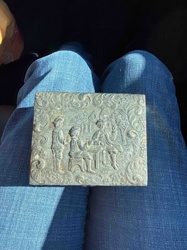
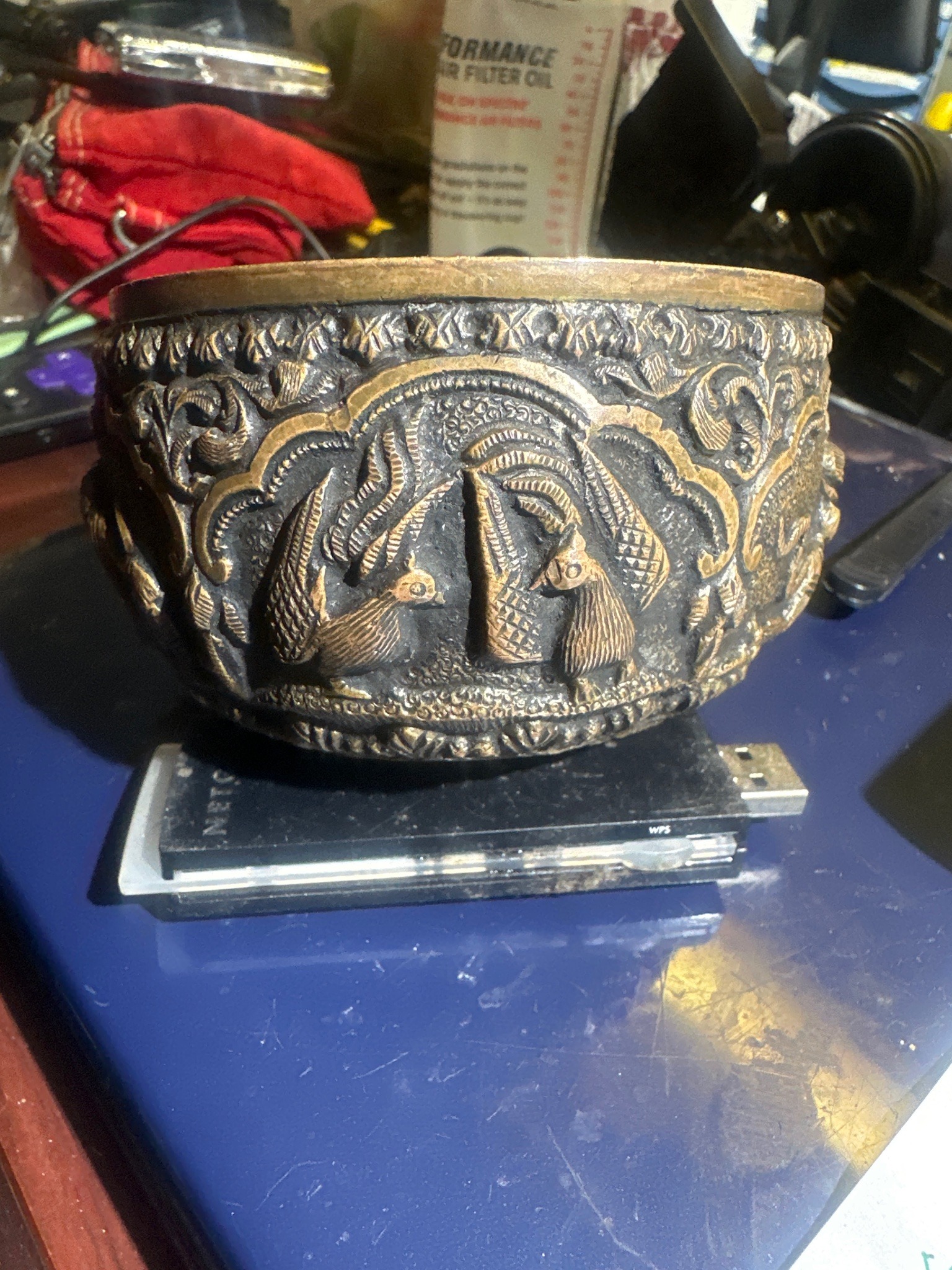
This object appears to be a small, circular metal vessel or bowl characterized by high-relief decorative motifs. The exterior showcases a repeating pattern of archways or cartouches containing bird-like figures, possibly peacocks or mythical hamsa, separated by dense foliate and scrollwork patterns. The construction suggests a traditional casting method, with a dark, possibly blackened or oxidized background that provides high contrast against the raised brassy or bronzed highlights. The piece exhibits a weathered patina with signs of age, including surface wear, minor pitting, and dust accumulation in the crevices of the relief. Its aesthetic is stylistically consistent with traditional metalwork from regions such as India or Myanmar (Burma), often referred to as koftgari or repoussé-style work, though it appears to be cast rather than hand-hammered. The rim is smooth and slightly thicker than the walls, showing a consistent golden hue. No maker's marks, signatures, or inscriptions are visible in the provided image to indicate a specific workshop or era. Consequently, the identification relies solely on visual stylistic characteristics which are typical of 20th-century decorative brassware produced for the export or local markets.
AI Appraisal Report

·AI can make mistakes·Verify before acting
Based on my visual examination of the provided image, I have analyzed this relief-decorated metal vessel, likely a brass or bronze alloy bowl. From what I can see, the piece displays stylistic traits associated with mid-to-late 20th-century South Asian or Southeast Asian decorative metalware. The high-relief figures and foliate patterns appear to be cast rather than hand-repoussé, which is typical for items produced for the export and tourist markets during that period. I cannot definitively verify the metal composition or the production technique from a photo alone; a physical inspection would be required to rule out modern electrotyping or to confirm if the vessel is a solid alloy. The value estimate is based on the assumption that this is a 20th-century decorative object in the style of Indian or Burmese traditional brassware. The market for this category of mass-produced or semi-handcrafted metalware is currently stable but modest, with most demand coming from interior decorators or collectors of regional folk art. The surface shows a weathered patina and accumulation in the relief, which collectors often prefer over polished surfaces, though these signs of age can also be artificially induced. If a physical examination were to reveal specific maker's marks or if it were confirmed as 19th-century handicraft, the value could increase slightly. However, should it be found to be a contemporary, low-quality resin cast or a very modern souvenir reproduction, the value would likely fall below $20. To confirm its origins, I would recommend an in-person examination by a specialist in Asian metalware to scrutinize the casting seams and wear patterns on the base.

Get your items appraised

Instant estimates of your treasures with AI-powered appraisals

Browse More Appraisals