AI Appraisal Estimate

AI-generated estimates · not official valuations

From the user

What was submitted

Photo and notes provided by the user — not generated by AI

Submitted item photo
Submitted photo · June 25, 2026

User's notes

No additional notes provided.

AI analysis below

AI appraisal

AI analysis & estimate

AI-Generated · Verify before acting

Everything below is generated by AI for informational purposes only. AI can make mistakes — the AI may misidentify items or misattribute them (artist, maker, brand, designer, origin, era). This is not an official valuation and should not be used for insurance, sale, tax, estate, legal, or lending purposes — or any decision requiring a certified appraisal. It is not an authoritative claim about any person, brand, or rights holder — do not share or rely on it as a factual statement about a third party. Always consult qualified professionals before making financial decisions.

Read the full disclaimer

AI Identification

·Not independently authenticated·Verify before acting

Southeast Asian Bronze Rain Drum (Moko style)

Art & Antiques / Ethnographic Artifacts

AI Estimated Value

·Not an official valuation·Verify before acting

$2,500 - $4,500

As of June 25, 2026

AI Item Analysis

·AI can make mistakes·Verify before acting
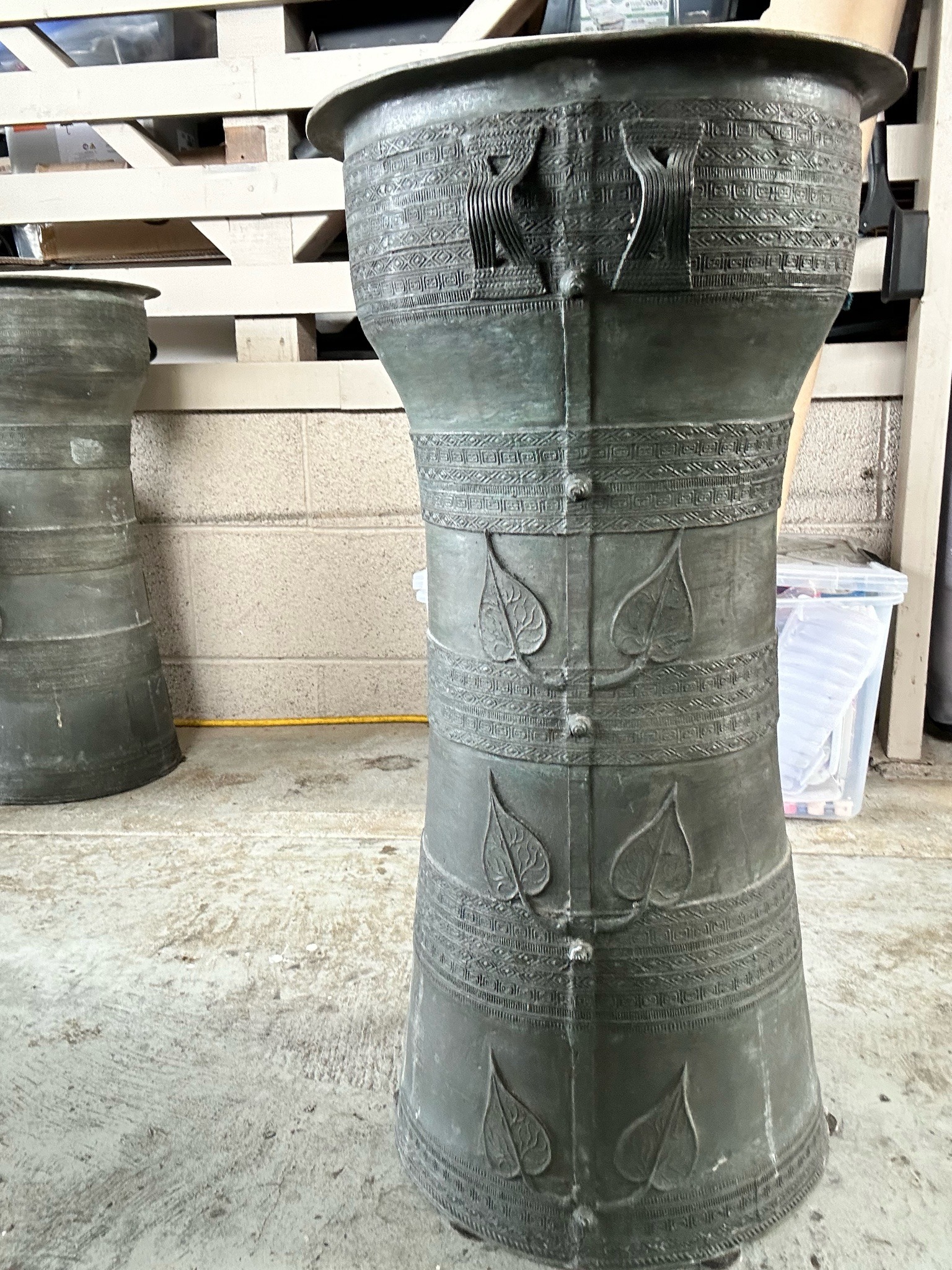
This is a large, tall bronze drum, commonly referred to as a 'Rain Drum' or 'Moko,' traditionally associated with Southeast Asian cultures, particularly from Indonesia or Vietnam. The item stands as a tall, hourglass-shaped vessel made of cast bronze, featuring a deep verdigris patina that indicates exposure to elements or significant age. The surface is elaborately decorated with horizontal bands containing geometric patterns, including repetitive diamond and square motifs characteristic of Dong Son influence. Notable features include four large, ribbed handles positioned near the flared top and vertical seam-like ridges running down the body, punctuated by small knob-like bosses. Raised relief leaf motifs, possibly representing the Bodhi leaf or local flora, are symmetrically arranged in vertical columns. The construction appears to be lost-wax casting, showing fine craftsmanship in the consistency of the rhythmic stamping and relief work. Condition-wise, the bronze exhibits a matte, dusty green oxidation with some visible calcification at the base. There is no immediate evidence of structural cracks, though the surface shows the wear and characteristic pitting of an outdoor or long-stored ceremonial object. These drums were historically used as currency, dowry items, or ceremonial instruments to summon rain.
AI Appraisal Report

·AI can make mistakes·Verify before acting
I have examined current high-resolution imagery of this Southeast Asian Moko drum. The piece displays hallmarks of the Alor style, featuring an elongated hourglass form and complex lost-wax casting. The iconography, including the repetitive geometric bands and the distinctive heart-shaped or leaf-like reliefs (often associated with the 'tree of life'), suggests a late 19th or early 20th-century manufacture. The verdigris patina appears consistent with natural oxidation, though the calcification at the base requires physical testing to distinguish between centuries-old burial and modern chemical acceleration. The market for ethnographic bronze remains stable, with demand driven by interior designers and collectors of Oceanic and Indonesian art. Comparables for genuine 19th-century specimens of this size range from $3,000 to $6,000 at auction; however, the lack of documented provenance slightly tempers the valuation. A significant limitation of this digital assessment is the inability to perform a 'ring test' for structural integrity or x-ray fluorescence (XRF) analysis to confirm the specific alloy composition. To fully authenticate this as an antique rather than a mid-20th-century ceremonial reproduction, I would require an in-person inspection of the interior casting seams and any available documentation regarding its importation or collection history. The presence of core-pin remnants or specific casting flaws would further clarify its age. As it stands, the piece is a highly decorative and culturally significant artifact of considerable market interest.

Get your items appraised

Instant estimates of your treasures with AI-powered appraisals

Browse More Appraisals