These notes were written by the person who submitted this item. Appraiser.AI has not verified them, and the AI's identification and estimate may rely on them.
AI Estimated Value
Not an official valuation
$50 - $100
AI estimate as of November 10, 2025 · verify with a professional before acting
AI-Generated · Verify before acting
Everything on this page is generated by AI for informational purposes only. AI can make mistakes — the AI may misidentify items or misattribute them (artist, maker, brand, designer, origin, era). This is not an official valuation and should not be used for insurance, sale, tax, estate, legal, or lending purposes — or any decision requiring a certified appraisal. It is not an authoritative claim about any person, brand, or rights holder — do not share or rely on it as a factual statement about a third party. Always consult qualified professionals before making financial decisions.
This analysis also relies on unverified notes provided by the user, which may be incomplete or inaccurate and could affect the result.
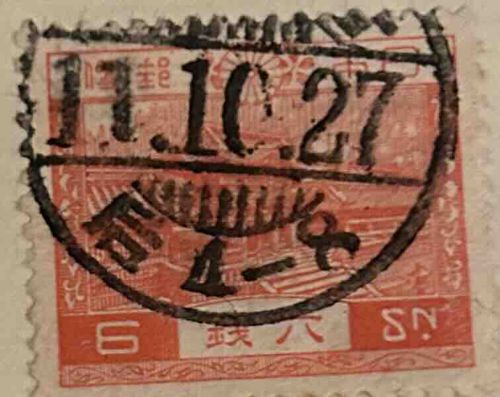
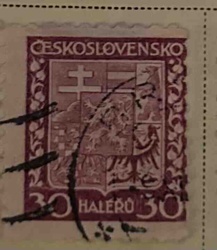
This item is a Japanese postage stamp, likely from the 'Kiku' (Chrysanthemum) series, featuring a prominent imperial chrysanthemum crest at its center. The stamp is predominantly red-orange in color, with a faint, intricate background design that appears to be pattern-based rather than a specific illustration. The numerical denomination '6' is visible in a red rectangle at the bottom left, accompanied by what appears to be Japanese characters for the denomination in the center bottom. The letters 'SN' (likely 'Sen') are also visible in a red rectangle at the bottom right corner. The stamp itself is rectangular with perforated edges, indicating its primary function as a postage stamp. It bears a heavy, circular black postmark that partially obscures the central design and the top left corner. The postmark clearly displays the date '11.10.27', written in a Western numerical format, which likely signifies the 11th year of an imperial era, 10th month, and 27th day, consistent with Japanese dating conventions of the early 20th century. Below this date, there are additional characters that are less clear due to the postmark's density, but they seem to indicate a location or further postal information, with some characters appearing to be 'ヒ4-8'. The corners of the stamp and the perforations show some wear and slight rounding, suggesting handling and age. The paper quality appears standard for postage stamps of its era. The heavy postmark indicates it was used for mailing, and while it confirms authenticity of use, it also affects the visual clarity of the stamp's underlying design. The style suggests it dates from the Meiji or early Taisho period in Japan.
AI Appraisal Report
I have examined the provided image of the Japanese 6 Sen 'Kiku' Chrysanthemum postage stamp with a postmark. This stamp is consistent with the design of early Japanese postal issues, likely from the Meiji or Taisho era, characterized by the imperial chrysanthemum crest and the 6 Sen denomination. The perforations and basic design elements appear authentic for the period. The postmark, dated '11.10.27', seems to follow a common Japanese calendar format indicating the 27th day of the 10th month in the 11th year of an era, which aligns with the historical period for this stamp series.
From the image, the stamp's condition is fair to good. It shows clear signs of use, including the heavy circular postmark that covers a significant portion of the design, especially the central chrysanthemum and top left. This heavy cancellation, while authenticating use, detracts from the stamp's visual appeal and, consequently, its value compared to a lightly canceled or uncancelled example. The perforations appear intact but show some rounding and wear, indicative of handling and age. The color, a red-orange, appears consistent with known examples of this issue.
In terms of market conditions, the 6 Sen 'Kiku' stamp is not particularly rare, especially in used condition. Demand is moderate, primarily from collectors specializing in Japanese philately. Similar used examples are readily available. Factors impacting value include the heavy postmark, which diminishes aesthetic appeal, and the general wear and tear. A clearer postmark or a higher-grade example would command a higher price point.
It is important to note that this assessment is based solely on the provided image. For full authenticity verification, a physical in-person examination would be required to assess paper type, watermark (if any), printing methods, and microscopic details. This would also allow for a more precise evaluation of any potential repairs, thinning, or hidden flaws that are not discernible from a photograph.