AI Appraisal Estimate

AI-generated estimates · not official valuations

From the user

What was submitted

Photo and notes provided by the user — not generated by AI

Submitted item photo
Submitted photo · June 6, 2026

User's notes

No additional notes provided.

AI analysis below

AI appraisal

AI analysis & estimate

AI-Generated · Verify before acting

Everything below is generated by AI for informational purposes only. AI can make mistakes — the AI may misidentify items or misattribute them (artist, maker, brand, designer, origin, era). This is not an official valuation and should not be used for insurance, sale, tax, estate, legal, or lending purposes — or any decision requiring a certified appraisal. It is not an authoritative claim about any person, brand, or rights holder — do not share or rely on it as a factual statement about a third party. Always consult qualified professionals before making financial decisions.

Read the full disclaimer

AI Identification

·Not independently authenticated·Verify before acting

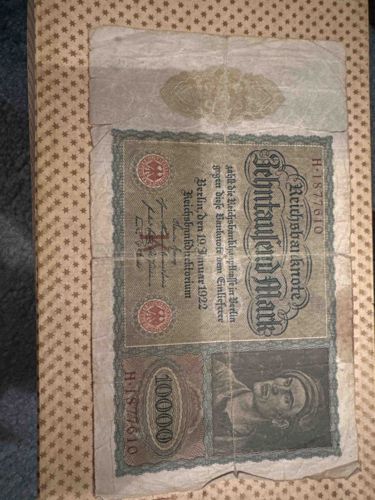
German Weimar Republic 10,000 Mark Banknote (1922)

Historical Currency / Numismatics

AI Estimated Value

·Not an official valuation·Verify before acting

$10.00 - $25.00

As of June 6, 2026

AI Item Analysis

·AI can make mistakes·Verify before acting
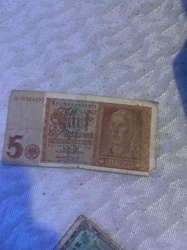
This is a German Reichsbanknote for 10,000 (Zehntausend) Mark, issued during the hyperinflation period of the Weimar Republic. The note is dated January 19, 1922, and was printed in Berlin. It features a predominantly green and brown color palette with intricate guilloche patterns and borders. A notable design element is the portrait on the lower right, known as the 'Vampire Note' because of a mythological interpretation of the neck of the figure (Portrait of a Young Man by Albrecht Dürer). The serial number H-1877610 is visible in two locations. The note bears two red Reichsbank seals and multiple facsimile signatures of the bank directors. Physically, the item shows significant wear consistent with circulation: there are heavy vertical and horizontal center folds, frayed and chipped edges, and some minor tearing at the margin creases. The paper appears aged and slightly darkened, with visible staining particularly on the upper left-hand side. Despite the wear, the primary text remains legible, and the overall graphic integrity is maintained. The reverse side, though not fully visible, typically features ornamental patterns and the denomination in numerals. This specific issue is a historical artifact representing the economic instability of early 1920s Germany.
AI Appraisal Report

·AI can make mistakes·Verify before acting
I have examined the digital representation of this 10,000 Mark 'Vampire Note' dated January 19, 1922. The note appears to be a genuine specimen from the Weimar Republic hyperinflation era, specifically the issue featuring the portrait by Albrecht Dürer. Based on the visual evidence, the note is in 'Very Good' to 'Fine' condition. I observe heavy circulation wear, including prominent cross-folding, edge fraying, and minor margin tears. The visible staining on the upper left and general paper toning are typical for the wood-pulp-based paper used during this transition period into hyperinflation. Market demand for this specific note is driven primarily by the 'Vampire' nickname—a popular legend suggesting a hidden face in the man's neck represents France draining Germany's lifeblood. Despite this historical intrigue, millones of these notes were printed, and they remain relatively common in the secondary market. Current auction comparables for this level of wear range from $10 to $25. Higher values are strictly reserved for 'Uncirculated' examples or rare serial number variants. While the typography, red seals, and intricate guilloche patterns appear consistent with authentic German state printing of 1922, this appraisal is subject to limitations. Definitive authentication would require a physical examination to verify the paper's watermark (the 'honeycomb' or 'hook-star' pattern), fiber texture, and ink fluorescence under UV light to rule out modern high-quality lithographic reproductions. Provenance documentation or a record from a recognized numismatic grading service (e.g., PMG) would be required to verify its historical lineage and provide a guaranteed grade.

Get your items appraised

Instant estimates of your treasures with AI-powered appraisals

Browse More Appraisals