These notes were written by the person who submitted this item. Appraiser.AI has not verified them, and the AI's identification and estimate may rely on them.
AI Estimated Value
Not an official valuation
$5 - $15
AI estimate as of November 9, 2025 · verify with a professional before acting
AI-Generated · Verify before acting
Everything on this page is generated by AI for informational purposes only. AI can make mistakes — the AI may misidentify items or misattribute them (artist, maker, brand, designer, origin, era). This is not an official valuation and should not be used for insurance, sale, tax, estate, legal, or lending purposes — or any decision requiring a certified appraisal. It is not an authoritative claim about any person, brand, or rights holder — do not share or rely on it as a factual statement about a third party. Always consult qualified professionals before making financial decisions.
This analysis also relies on unverified notes provided by the user, which may be incomplete or inaccurate and could affect the result.
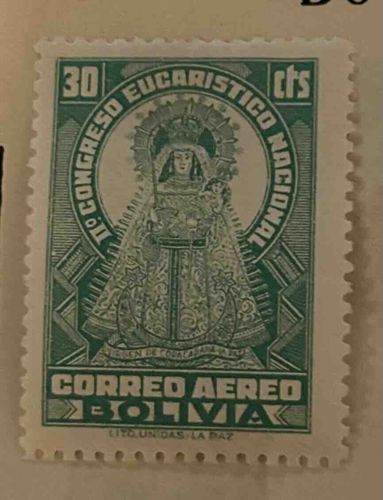
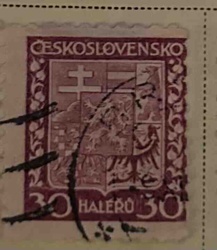
This is a vintage Bolivian airmail postage stamp, predominantly green in color on a white paper background, featuring a religious icon. The stamp has perforated edges, typical of postage stamps, and appears to be in relatively good, unused condition with no obvious tears or significant creasing, although the exact quality of the perforations and gum is not discernible from the image. The central motif is an ornate depiction of the Virgin Mary, possibly Our Lady of Copacabana, holding the Christ Child. Both figures are adorned with elaborate crowns and richly patterned robes, and the Virgin Mary is surrounded by a halo-like burst of light or rays. The main image is encircled by text 'IIo CONGRESO EUCARISTICO NACIONAL'. In the upper left corner, the denomination '30' is visible, and in the upper right, 'cts' (likely indicating centavos) is present. Below the central image, the words 'CORREO AEREO' are prominently displayed in a bold, sans-serif font, followed by 'BOLIVIA' in an even larger, stylized font with a decorative horizontal line beneath it. At the very bottom, in small print, 'LITO. UNIDAS. LA PAZ' can be identified, indicating the lithographer or printer and the city of production. The overall design suggests a commemorative issue, likely for the 'Second National Eucharistic Congress' in Bolivia. The style of the artwork and typography points to an early to mid-20th-century period. The craftsmanship appears to be of standard philatelic quality for the era, with clear, crisp printing. The stamp itself is rectangular, with proportional dimensions consistent with standard postage stamp sizes, though exact measurements are not provided.
AI Appraisal Report
Based on my visual examination of the provided image, this Bolivian Airmail Stamp, commemorating the "II Congreso Eucaristico Nacional," appears to be in very good condition. The perforations seem intact and largely undamaged, and there are no visible tears, creases, or major thins that would significantly detract from its value. The printing is clear and well-centered, which is a positive attribute. The stamp's design, featuring the Virgin Mary and Christ Child, is typical of commemorative issues for religious events in the mid-20th century.
From the image alone, authenticity appears likely; there are no immediate red flags suggesting a forgery, and the 'LITO. UNIDAS. LA PAZ' imprint is consistent with known Bolivian philatelic publishers. However, definitive authentication would require an in-person examination to assess paper type, watermarks (if any), gum condition, and printing details under magnification. I cannot confirm if it is unused with original gum or if it has been hinged, which impacts value.
Market-wise, this is a relatively common and accessible issue from Bolivia. While it's a handsome stamp, it doesn't represent a major rarity. Demand is steady among collectors of Latin American stamps and topical collectors focused on religious themes or airmail issues. Comparable stamps from this period and region in similar condition typically fall within a modest price range. The factors impacting value most here are its excellent apparent condition and the completeness of the design.
To fully authenticate and precisely value this stamp, I would need to physically inspect it to: assess the gum condition (original, regummed, or no gum), check for hidden faults, and verify the watermark (if applicable). Without this, the value provided is an estimate based on visual information only.