AI estimate as of November 10, 2025 · verify with a professional before acting
AI-Generated · Verify before acting
Everything on this page is generated by AI for informational purposes only. AI can make mistakes — the AI may misidentify items or misattribute them (artist, maker, brand, designer, origin, era). This is not an official valuation and should not be used for insurance, sale, tax, estate, legal, or lending purposes — or any decision requiring a certified appraisal. It is not an authoritative claim about any person, brand, or rights holder — do not share or rely on it as a factual statement about a third party. Always consult qualified professionals before making financial decisions.
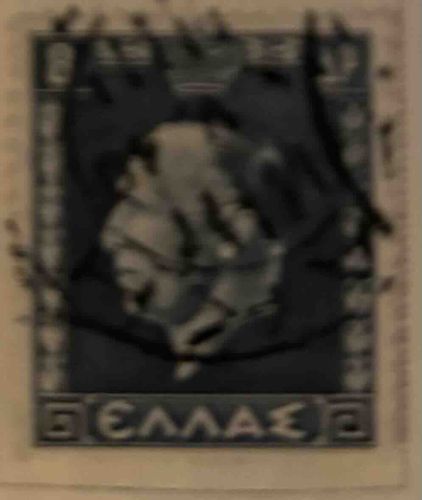
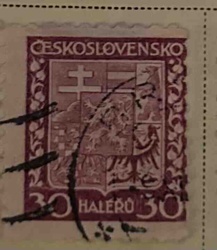
This item is a vintage Greek postage stamp, likely dating from the late 19th or early 20th century, featuring a portrait of King George I of Greece. The stamp is predominantly dark blue or indigo in color, with a lighter, possibly off-white or light grey, depiction of the king's profile facing right. The monarch wears what appears to be military attire, including a high collar and epaulets. Above the portrait, a faint impression of a crown can be discerned. The stamp's border is intricately designed with a decorative pattern, possibly Greek key or a similar geometric motif, enclosing the central image. At the bottom, the word 'ΕΛΛΑΣ' (ELLAS), meaning Greece, is clearly visible in a white or light-colored font against a dark background. Numerals, likely indicating the stamp's denomination, are present in the upper corners, but their exact values are unclear due to the image's blurriness. The stamp itself appears to be rectangular, with perforation marks faintly visible along its edges, indicating it was separated from a sheet. The overall condition suggests some wear consistent with age and handling, including what looks like a cancellation mark across the top-right portion and possibly some corner rounding. The paper beneath the stamp is a light, somewhat faded cream color, suggesting a mount or an album page. The printing quality, despite the blur, appears to be relatively high for its time, showcasing fine lines in the portrait and clear text. This stamp is a typical example of those issued during the reign of King George I, designed for postal communication within Greece or for international correspondence.
AI Appraisal Report
Based on my visual examination of the provided image, this Greek postage stamp featuring King George I appears to be a common issue from his long reign.
The stamp's condition, from what I can discern, shows wear consistent with age and use. There are visible perforation marks, and what seems to be a cancellation mark on the top-right. The paper aging and possible corner rounding further indicate its vintage. While authenticity appears likely given the typical design for this period, a definitive assessment would require in-person examination. Without physically handling the stamp, I cannot verify paper type, printing methods, or watermarks, which are crucial for authentication and distinguishing between genuine issues, forgeries, or reprints.
From a market perspective, Greek stamps from the reign of King George I are generally not considered rare unless they have specific varieties, errors, or exceptional centering and condition (e.g., unused or very fine used copies). The visible cancellation suggests it was a circulated stamp. Common used examples typically fetch modest prices. Factors impacting value include the precise denomination (unclear from the blurry image), color variation, and if it's part of a known rarity.
Demand for such common issues is steady among collectors of Greek philately but not particularly high. Until I can physically examine the stamp to confirm its precise catalog number, condition without imaging artifacts, and rule out any potential forgeries or commonplace varieties, I am estimating a conservative value. A full in-person inspection and comparison with known philatelic catalogs would be necessary for a precise valuation and to confirm authenticity beyond doubt. This would involve scrutinizing the paper, gum (if unused), precise print details, and the type of cancellation.