These notes were written by the person who submitted this item. Appraiser.AI has not verified them, and the AI's identification and estimate may rely on them.
AI Estimated Value
Not an official valuation
$5 - $15
AI estimate as of November 10, 2025 · verify with a professional before acting
AI-Generated · Verify before acting
Everything on this page is generated by AI for informational purposes only. AI can make mistakes — the AI may misidentify items or misattribute them (artist, maker, brand, designer, origin, era). This is not an official valuation and should not be used for insurance, sale, tax, estate, legal, or lending purposes — or any decision requiring a certified appraisal. It is not an authoritative claim about any person, brand, or rights holder — do not share or rely on it as a factual statement about a third party. Always consult qualified professionals before making financial decisions.
This analysis also relies on unverified notes provided by the user, which may be incomplete or inaccurate and could affect the result.
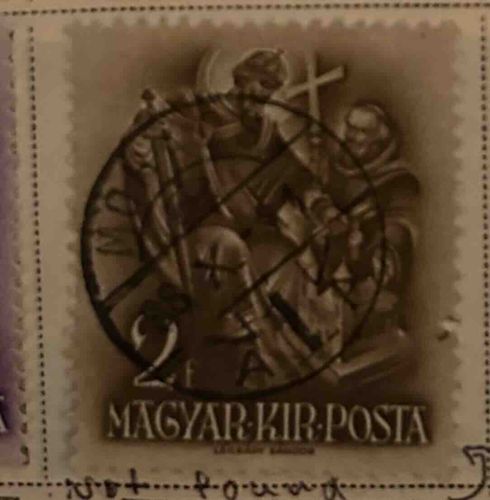
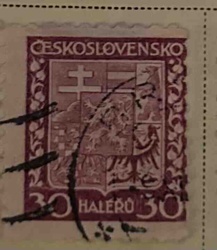
This item is a historical Hungarian postage stamp, likely from the early to mid-20th century, given the stylistic elements and text. The stamp features a sepia-toned or monochromatic illustration depicting two prominent historical figures. One figure, possibly King Stephen I, is shown seated or enthroned, holding a scepter or staff, with a cross visible in the background. The second figure, likely Saint Gellért (Gerard), appears to be kneeling or presenting something to the king. A prominent circular postmark partially obscures the central image but indicates a denomination of '2 P' or '2 FIL' (representing 2 Filler, a former Hungarian currency unit). Below the illustration, the text 'MAGYAR KIR. POSTA' is clearly visible, which translates to 'Hungarian Royal Post'. This suggests the stamp was issued during a period when Hungary was a kingdom, further narrowing down its potential age. The stamp exhibits classic perforations along all four edges, indicating it was part of a sheet. The overall condition appears used, as evidenced by the postmark. The colors are muted, presenting a vintage aesthetic. The craftsmanship reflects typical philatelic printing techniques of the era, likely offset or photogravure, designed for both aesthetic appeal and security against counterfeiting. The focus on historical figures underscores a nationalistic or commemorative theme, common in stamps of this period. No major physical damage like tears or significant creasing is immediately apparent, though the resolution limits a definitive assessment of minor wear. The postmark itself, while obscuring the image, also adds to the stamp's historical authenticity as a circulated item.
AI Appraisal Report
Based on my visual examination of the provided image, this Hungarian postage stamp featuring King Stephen I and Saint Gellért appears to be a used, postmarked example from the 'MAGYAR KIR. POSTA' era, likely early to mid-20th century. The sepia-toned or monochromatic illustration, along with the '2 P' or '2 FIL' denomination, is consistent with Hungarian issues from that period. The perforations are present on all four edges, and the overall vintage aesthetic is typical. The circular postmark, while obscuring a portion of the central image, confirms its used status and authenticity as a circulated item.
From the image, the stamp appears to be in reasonably good used condition, with no obvious major tears or significant creasing. Minor wear should be expected for a circulated stamp of this age. Authenticity seems strong based on the 'MAGYAR KIR. POSTA' inscription, design, and apparent typography. Market conditions for common, used Hungarian stamps from this period are generally stable but not particularly high. Comparables would include other definitive or commemorative issues from the interwar or post-WWI era in similar used condition. Demand for such items is primarily from generalist collectors of European stamps or specialist Hungarian philatelists.
Key factors impacting value include the precise issue date, actual denomination (2 Filler was a common value), and the specific series. The postmark itself can sometimes add value if it's a rare cancel or a complete, legible date from a historically significant event, though this does not appear to be the case here. Rarity is generally low for common definitive issues in used condition from this period.
It is crucial to note that my assessment of condition and authenticity is based solely on the provided image. A full, in-person examination would be necessary to verify the precise paper type, gum (if any residual), exact printing method, and to detect any subtle flaws like thinning, repairs, or re-perforations that cannot be seen in an image. Such an inspection, potentially alongside provenance documentation (if available) or even scientific testing for paper and ink, would be needed for absolute authentication and a more precise determination of value.