AI Appraisal Estimate

AI-generated estimates · not official valuations

From the user

What was submitted

Photo and notes provided by the user — not generated by AI

Submitted item photo
Submitted photo · June 20, 2026

User's notes

Made in Japan

AI analysis below

AI appraisal

AI analysis & estimate

AI-Generated · Verify before acting

Everything below is generated by AI for informational purposes only. AI can make mistakes — the AI may misidentify items or misattribute them (artist, maker, brand, designer, origin, era). This is not an official valuation and should not be used for insurance, sale, tax, estate, legal, or lending purposes — or any decision requiring a certified appraisal. It is not an authoritative claim about any person, brand, or rights holder — do not share or rely on it as a factual statement about a third party. Always consult qualified professionals before making financial decisions.

Note

This analysis also relies on unverified notes provided by the user, which may be incomplete or inaccurate and could affect the result.

Read the full disclaimer

AI Identification

·Not independently authenticated·Verify before acting

Vintage Japanese Eiraku-style Eggshell Porcelain Covered Sugar Bowl and Creamer Set

Antique and Vintage Ceramics - Japanese Export Porcelain

AI Estimated Value

·Not an official valuation·Verify before acting

$45.00 - $65.00

As of June 20, 2026

AI Item Analysis

·AI can make mistakes·Verify before acting
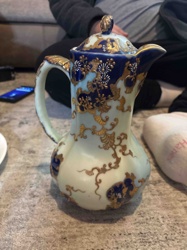
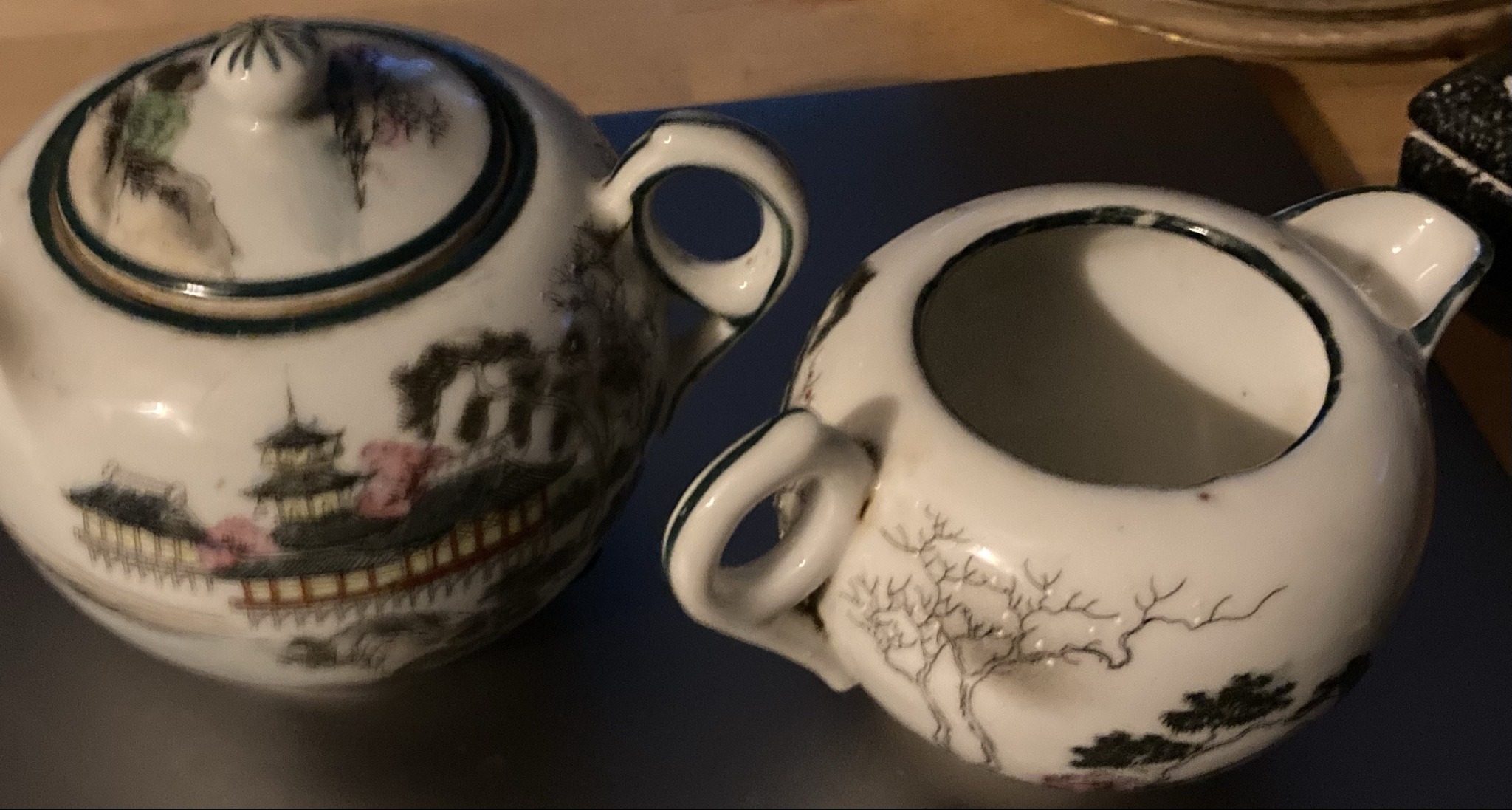
This is a two-piece porcelain set consisting of a covered sugar bowl and a matching creamer, originating from Japan in the mid-20th century. The pieces are crafted from fine, translucent 'eggshell' porcelain, a material renowned for its thinness and high firing temperature. The decorative program features hand-painted and transfer-accented lithophane-style landscapes in a traditional Japanese 'Nihonga' aesthetic. The imagery showcases a scenic pagoda, traditional architectural structures, and stylized cherry blossoms in soft pink hues against a backdrop of muted grey and green landscapes. Each vessel is globose in shape with delicate, high-mounted loop handles. The rims and handles are accented with a dark teal or green band. The sugar bowl includes a fitted lid with a matching landscape motif and a simple finial. The set demonstrates mid-century Japanese export craftsmanship, popularized during the Occupation and post-WWII eras. The condition appears fair to good for its age, with visible particulate and minor staining near the seams, common in vintage ceramics. There is some softening of the hand-painted details and slight fading of the border gilding or banding. No major cracks or chips are immediately visible in the provided image, though small stress lines near the handle attachments are typical for porcelain of this thinness.
AI Appraisal Report

·AI can make mistakes·Verify before acting
I have examined the digital images of this Japanese eggshell porcelain creamer and sugar bowl set. Based on the globose forms, the 'Nihonga' style landscape featuring a pagoda and cherry blossoms, and the specific teal banding, this set is identified as mid-20th-century Japanese export ware, likely dating from the late 1940s to the 1950s. The 'eggshell' quality suggests a high-fire kaolin composition typical of the period's artisanal production for the Western market. The condition is noted as fair to good; the staining and particulate near the seams suggest use or storage in a high-humidity environment, which can sometimes lead to 'bleeding' of the transfer-ware base under the hand-painted accents. The market for mid-century Japanese export porcelain is currently saturated, with vast quantities of similar lusterware and eggshell tea sets available on the secondary market. While the Eiraku style is aesthetically pleasing, these pieces were mass-produced for the Occupation-era and post-WWII export trade, limiting their rarity. The value is driven primarily by decorative appeal rather than investment-grade scarcity. Limitations: A definitive valuation is restricted by the digital format. In-person examination is required to check for 'flea bites' on the rims, hairline fractures invisible to the camera, and to verify the presence of a 'Kutani' or 'Made in Occupied Japan' backstamp, which could slightly influence collector interest. Microscopic inspection would be necessary to distinguish the exact ratio of hand-painting versus lithographic transfer. No scientific testing was performed; provenance documentation regarding the original purchase would aid in further historical refinement.

Get your items appraised

Instant estimates of your treasures with AI-powered appraisals

Browse More Appraisals