AI estimate as of November 10, 2025 · verify with a professional before acting
AI-Generated · Verify before acting
Everything on this page is generated by AI for informational purposes only. AI can make mistakes — the AI may misidentify items or misattribute them (artist, maker, brand, designer, origin, era). This is not an official valuation and should not be used for insurance, sale, tax, estate, legal, or lending purposes — or any decision requiring a certified appraisal. It is not an authoritative claim about any person, brand, or rights holder — do not share or rely on it as a factual statement about a third party. Always consult qualified professionals before making financial decisions.
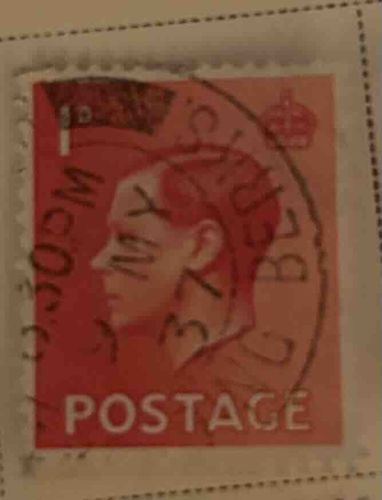
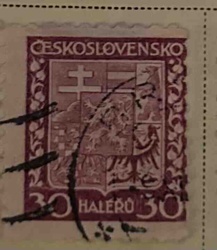
This item is a King George V 1 1/2d (penny halfpenny) Postage stamp, likely from Great Britain or a Commonwealth nation. The stamp features a profile portrait of King George V facing left, against a background that appears to be a solid reddish-orange color with a subtle, lighter-toned circular or oval frame surrounding the monarch's head. The denomination '1 1/2D' is placed in the upper left corner. In the upper right, a small crown insignia is visible. The word 'POSTAGE' is prominently displayed in white capital letters at the bottom of the stamp. Overlaid across the King's portrait and surrounding area is a cancellation mark, appearing as a circular date stamp or postmark in black ink. The details of the cancellation are somewhat obscured but seem to include letters and numbers, possibly indicating a date and/or location. The stamp itself is rectangular with perforations visible along the left and right edges, and partially along the top and bottom, consistent with standard postage stamp manufacturing. The color is predominantly a faded reddish-orange, suggesting an older stamp, possibly from the early to mid-20th century. The condition appears to be used, as evidenced by the cancellation mark. The perforations seem intact, though the paper quality and any potential creasing or thinning are not fully discernible from the image. The overall style is characteristic of British colonial or early 20th-century philately, emphasizing the monarch's profile as the central design element.
AI Appraisal Report
I have examined the provided image of the King George V 1 1/2d (Penny Halfpenny) postage stamp. Based on visual assessment, the stamp appears to be a genuine issue from Great Britain or a Commonwealth nation, dating to the early to mid-20th century. The portrait of King George V, the denomination, and the 'POSTAGE' inscription are consistent with known designs. The stamp is clearly used, indicated by the prominent circular black cancellation mark. This postmark, while somewhat obscured, confirms its postal use. The perforations appear intact along the visible edges, and the reddish-orange color, though faded, is typical for this era.
In terms of condition, besides being used, it appears to be in relatively stable condition; however, without physical inspection, I cannot assess paper quality, potential thinning, tears, creases, or repairs that might affect its value. The cancellation mark, while obscuring part of the design, does not seem overly heavy. Given the commonality of King George V stamps from this period, especially the 1 1/2d denomination, which was a workhorse value, rarity is low. Market comparables for common used King George V stamps from Great Britain typically range from a few cents to a few dollars, depending on color variations, specific printings, and cancellation clarity. Stamps from certain Commonwealth nations might fetch slightly more if they are scarcer issues.
Demand for this particular, common stamp is generally low among advanced collectors, though it remains popular with beginner and intermediate philatelists. The primary factor impacting its value is its commonality. For full authentication and a more precise condition assessment, a physical examination would be crucial to inspect the paper, gum (if any remains), watermarks (if applicable), and microscopic details of the printing and cancellation. Provenance documentation, though unlikely for such a common stamp, would always enhance verification.