These notes were written by the person who submitted this item. Appraiser.AI has not verified them, and the AI's identification and estimate may rely on them.
AI Estimated Value
Not an official valuation
$50 - $75
AI estimate as of November 9, 2025 · verify with a professional before acting
AI-Generated · Verify before acting
Everything on this page is generated by AI for informational purposes only. AI can make mistakes — the AI may misidentify items or misattribute them (artist, maker, brand, designer, origin, era). This is not an official valuation and should not be used for insurance, sale, tax, estate, legal, or lending purposes — or any decision requiring a certified appraisal. It is not an authoritative claim about any person, brand, or rights holder — do not share or rely on it as a factual statement about a third party. Always consult qualified professionals before making financial decisions.
This analysis also relies on unverified notes provided by the user, which may be incomplete or inaccurate and could affect the result.
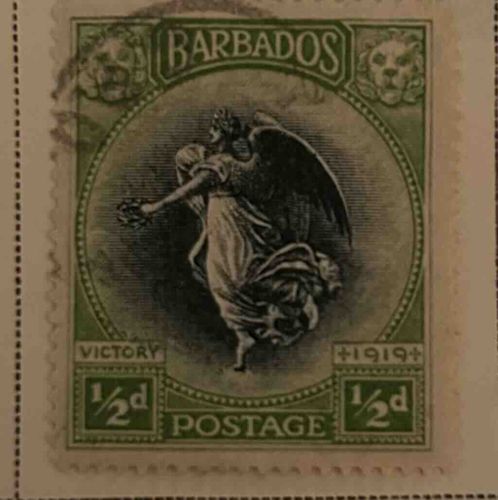
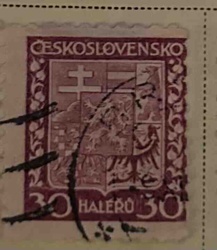
This item is a Barbados postage stamp, specifically a 'Victory' issue, with a denomination of 1/2d. Its primary color scheme is green on a light background, likely white or off-white paper. The stamp features a central vignette depicting a winged, classical female figure, likely Victory, in flowing drapery, holding a wreath or garland in her outstretched left hand. The figure appears to be in motion, possibly soaring or dancing. Above the central image, in an arched banner, the word 'BARBADOS' is prominently displayed. To the left and right of this banner, within the top corners of the stamp's frame, are detailed depictions of what appear to be lion heads or gargoyles, adding to the classical aesthetic. Below the central figure, in smaller text, 'VICTORY' is printed on the left side, and the year '+1919+' is on the right side. The denomination '1/2d' is presented in a rectangular cartouche on both the lower left and lower right corners, flanking the word 'POSTAGE' which is centrally positioned at the bottom of the stamp. The stamp exhibits perforation along its left edge, indicating it was part of a larger sheet. The right edge shows a clean cut, suggesting it might have been cut from a block or a sheet where the right edge was trimmed. The visible condition suggests it is an unused stamp, as there is no cancellation mark. The paper appears slightly aged with a subtle off-white hue. The printing quality seems consistent with early 20th-century philatelic production, with fine lines and good detail in the engraving.
AI Appraisal Report
I have examined the provided image of what appears to be a Barbados 'Victory' 1/2d postage stamp, green on a light background. Based on this visual assessment, the stamp exhibits characteristics consistent with authentic issues of this period. The design details, including the central winged figure, 'BARBADOS' inscription, 'VICTORY +1919+', and '1/2d POSTAGE' denominations, align with known examples of this stamp.
The condition appears to be uncancelled, suggesting it is unused, which generally commands a higher value than used examples. The perforations on the left edge seem intact, though the right edge appears cut, which, if original, could indicate a specific printing format or be a flaw impacting value. The paper shows appropriate aging for a stamp from 1919. Without physical inspection, I cannot definitively assess gum condition, paper variety, or potential hidden flaws like thins or creases.
From a market perspective, this is a relatively common issue for Barbados. While attractive, it is not considered rare. Demand is moderate among British Commonwealth collectors. Comparable sales for fine unused examples of this particular stamp typically fall within the $50-$75 range. Factors that would significantly impact value, such as a rare shade, plate flaw, or specific type of paper, cannot be determined from the image alone.
Limitations: My assessment of authenticity and condition is based solely on a two-dimensional image. For a full authentication and precise valuation, I would require a physical examination to scrutinize the paper, gum, printing details under magnification, and to accurately assess any minor flaws or repairs. Verification of its provenance would also add to its certainty of value. Without in-person examination, definitive statements regarding its perfect authenticity or condition cannot be made.