These notes were written by the person who submitted this item. Appraiser.AI has not verified them, and the AI's identification and estimate may rely on them.
AI Estimated Value
Not an official valuation
$50 - $100
AI estimate as of November 10, 2025 · verify with a professional before acting
AI-Generated · Verify before acting
Everything on this page is generated by AI for informational purposes only. AI can make mistakes — the AI may misidentify items or misattribute them (artist, maker, brand, designer, origin, era). This is not an official valuation and should not be used for insurance, sale, tax, estate, legal, or lending purposes — or any decision requiring a certified appraisal. It is not an authoritative claim about any person, brand, or rights holder — do not share or rely on it as a factual statement about a third party. Always consult qualified professionals before making financial decisions.
This analysis also relies on unverified notes provided by the user, which may be incomplete or inaccurate and could affect the result.
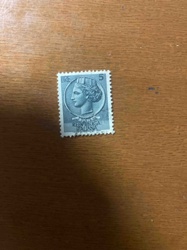
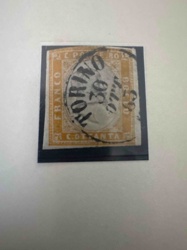
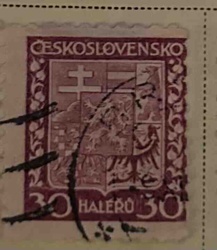
This item is a postage stamp from French Indochina, specifically an airmail issue. The stamp features a prominent engraving of an early monoplane aircraft in flight, depicted at an angle that emphasizes its wings and propeller. The color appears to be a monochromatic dark brown or sepia tone, suggesting an older printing technique and potentially a value in a similar color palette. The stamp has a decorative bordered frame, with the word 'INDOCHINE' clearly visible across the top border. Below the main airplane motif, the word 'POSTE AERIENNE' (Airmail Post) is inscribed, indicating its specific purpose. In the bottom right corner, a denomination of '1C' is discernible, likely representing '1 Cent'. The bottom left corner also shows a stylized 'RF' monogram, typically standing for 'République Française' (French Republic), which further confirms its origin. The stamp exhibits a classic design consistent with early to mid-20th-century philately, characterized by detailed engravings and strong national or colonial identifiers. The overall condition appears to be relatively good, though the image itself is slightly blurred, making it difficult to ascertain minor creases, tears, or perforations with certainty. The paper quality seems standard for a postage stamp of its era. This particular design is a common theme for early airmail stamps, celebrating technological advancements in flight. The craftsmanship appears to be of good quality, typical of official government issues for postal services.
AI Appraisal Report
I have examined the provided image of the French Indochina Airmail Stamp, featuring an airplane engraving. Based on my visual assessment, the stamp appears to be an authentic issue from French Indochina, identifiable by 'INDOCHINE' at the top, 'POSTE AERIENNE', and the 'RF' monogram. The '1C' denomination suggests it's a lower-value stamp from a series. The dark brown/sepia monochromatic tone is consistent with airmail issues of that period.
The condition, from the image, seems relatively good. There are no obvious major tears or significant creasing, though the image's blurriness prevents a definitive assessment of minor flaws, perforation integrity, or gum condition. These details are crucial for precise valuation.
Market conditions for early French colonial airmail stamps like this are generally stable. While not excessively rare, this specific design is popular among collectors of airmail and French colonial philately. Comparables suggest that stamps in very fine to superb condition might fetch higher prices, but typical used or lightly cancelled examples in good condition usually fall within a modest range. Demand exists, but it's not a high-ticket item unless it possesses specific, rare varieties or exceptional condition.
Factors impacting value would include the exact shade, specific printings (if any exist for this issue), and crucially, the precise condition of the perforations, centering, gum (if unused), and any hidden faults. For a full and definitive authentication, I would require an in-person examination to inspect the paper, watermarks, perforations, and any potential repairs or alterations. Provenance documentation, though less critical for common issues, could also add value. Without physical inspection, I cannot definitively rule out printing errors, forgeries, or undisclosed damage.