These notes were written by the person who submitted this item. Appraiser.AI has not verified them, and the AI's identification and estimate may rely on them.
AI Estimated Value
Not an official valuation
$2 - $10
AI estimate as of November 9, 2025 · verify with a professional before acting
AI-Generated · Verify before acting
Everything on this page is generated by AI for informational purposes only. AI can make mistakes — the AI may misidentify items or misattribute them (artist, maker, brand, designer, origin, era). This is not an official valuation and should not be used for insurance, sale, tax, estate, legal, or lending purposes — or any decision requiring a certified appraisal. It is not an authoritative claim about any person, brand, or rights holder — do not share or rely on it as a factual statement about a third party. Always consult qualified professionals before making financial decisions.
This analysis also relies on unverified notes provided by the user, which may be incomplete or inaccurate and could affect the result.
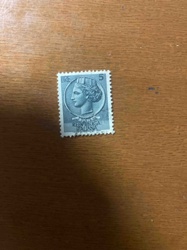
This item is an Austrian postage stamp, as indicated by the prominent 'OESTERREICH' text at the top. The stamp features a central engraving depicting a smiling man, presumably in traditional Austrian or Alpine attire, including a distinct cap or hat. His expression is jovial, and he appears to be holding a small glass or mug in his left hand (viewer's right). In the background, there's a suggestion of a landscape with hills or mountains and possibly architectural elements like a church or castle spire. The overall color scheme is predominantly a dark blue or indigo against a lighter, possibly off-white or cream-colored paper. The stamp exhibits a classic perforated edge, suggesting it was part of a sheet and intended for postal use. In the lower left corner, a number '5' is visible within a circular or oval design, likely indicating the postal denomination. Below the central image, there are additional, less legible textual elements, potentially indicating the currency 'GROSCHEN' or similar. The printing quality appears to be average for a postage stamp of its era, using an intaglio or similar process that gives depth to the dark blue lines. The condition appears to be used, as evidenced by a faint circular cancellation mark visible on the lower right portion of the stamp, partially obscuring some of the design. The perforations seem intact, though the paper color may show some age-related toning or slight discoloration. The artistic style suggests an early to mid-20th-century period, possibly between the 1920s and 1950s, characterized by illustrative rather than photographic representation. The image quality makes it challenging to identify any specific maker's marks or detailed manufacturing information beyond what is visible.
AI Appraisal Report
I have carefully examined the provided image of the Austrian 'Oesterreich' postage stamp featuring a smiling man. The authenticity appears to be high based on the visible 'OESTERREICH' text, design style consistent with early to mid-20th century Austrian issues, and standard perforations. The visible circular cancellation mark confirms it was used for postal purposes. However, a definitive authenticity verification would require in-person examination to check paper type, watermarks, gum condition (if applicable), and printing characteristics under magnification. Variations in printing, paper, and gum can significantly impact value.
The condition appears to be 'used' with a clear cancellation, which generally reduces value compared to unused examples. The perforations seem intact, but the image quality makes it difficult to assess any minor tears, thins, or creases. Color toning or discoloration due to age or environmental exposure is common for stamps of this era.
This stamp, likely a 5 Groschen denomination, falls into a category of common definitive issues from Austria. While the design is charming, these stamps were produced in large quantities. Demand is steady among specialized collectors of Austrian philately, but not exceptionally high for used examples in average condition. Rarity is low for this type of issue.
Factors significantly impacting value include the precise issue year (which is not visible), specific shade variations, centring, and the clarity and completeness of the cancellation. A "higher grade" cancellation or a unique postal history connection could slightly increase value. Given the visible condition and general commonality, a realistic appraisal for this used example in good, but not exceptional, condition is in the range of $2 - $10. Without physical inspection to verify paper, gum, hidden flaws, and finer printing details, this valuation is an estimate based solely on the provided image.