AI estimate as of September 14, 2025 · verify with a professional before acting
AI-Generated · Verify before acting
Everything on this page is generated by AI for informational purposes only. AI can make mistakes — the AI may misidentify items or misattribute them (artist, maker, brand, designer, origin, era). This is not an official valuation and should not be used for insurance, sale, tax, estate, legal, or lending purposes — or any decision requiring a certified appraisal. It is not an authoritative claim about any person, brand, or rights holder — do not share or rely on it as a factual statement about a third party. Always consult qualified professionals before making financial decisions.
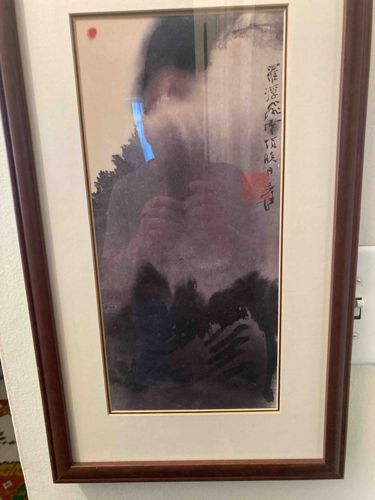
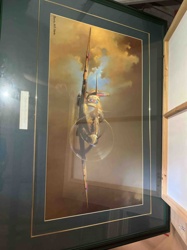
This item is a framed Asian-style artwork, likely an ink wash painting or print, featuring calligraphy. The artwork is presented vertically within a dark brown wooden frame, which appears to be a standard profile with a slight convex curve or rounded edge, indicating a common contemporary framing style. The artwork itself is under glass or acrylic, which exhibits significant reflections, obscuring parts of the image, particularly a figure or a dark mass in the upper center and a blue reflection from an external source. The visible part of the artwork depicts a monochrome scene, primarily in shades of gray, black, and possibly some subtle purple or brown tones, suggesting an ink wash technique. The lower portion features dark, painterly forms that resemble trees or abstract landscapes, executed with varying brushstrokes that denote depth and texture. In the upper right quadrant, there is a column of vertical Asian calligraphy, rendered in black ink, showcasing intricate strokes. Adjacent to the calligraphy, slightly below its mid-point, a distinctive bright red rectangular stamp, typical of artist or collector seals in Asian art, is visible. Above the obscured central figure and to the left, a small, distinct red circular mark is present, which could be another seal or a unique artistic element. The artwork is matted with a cream or off-white mat board, which provides a clean border between the image and the frame. The overall condition of the visible painting is difficult to assess due to reflections but appears to be stable, with no obvious major damage to the paper or canvas beyond some apparent fading or aging of the colors, especially in the lighter areas. The framematerial seems to be solid wood, and the construction appears sound, with visible corner joins suggesting a well-made frame. The style hints at traditional East Asian art, possibly contemporary, given the framing and potential print quality, though without closer inspection, it's hard to definitively place an age or specific period. The artwork has a serene, contemplative quality, characteristic of ink wash paintings.
AI Appraisal Report
Based on my visual examination of the provided image, this framed Asian calligraphy and ink wash painting presents as a decorative piece. The visible portions suggest a traditional East Asian aesthetic, characterized by an ink wash scene with abstract, landscape-like forms and a column of vertical calligraphy. The presence of a red rectangular artist's or collector's seal and a circular red mark further aligns with typical attributes of such artwork.
From the image, the painting itself appears to be in stable condition, though reflections significantly obscure large sections, making a definitive assessment of detail, paper integrity, or potential discoloration difficult. The framing, a dark brown wooden frame with a cream mat, is standard contemporary style and appears sound. The overall presentation is neat and professionally framed.
Authenticity is difficult to ascertain from an image alone. While the elements are consistent with East Asian art, without close inspection, it is impossible to determine if this is an original ink wash painting, a high-quality print, or a reproduction. The market for decorative Asian-style artwork is broad, with prints and reproductions being widely available at lower price points. Original, unsigned works by unknown artists, even if authentic, generally command modest values unless specific artistic merit or age is evident. Factors such as the artist's identity, the quality of the brushwork (which is hard to fully appreciate due to reflections), and the age of the piece are crucial for higher valuation.
To fully verify authenticity and provide a more precise valuation, an in-person examination would be critical. This would allow me to assess the paper quality, ink application (to distinguish between original brushstrokes and print), the true age and condition of the art, and to identify any watermarks or specific artist signatures not clearly visible. Provenance documentation, if available, linking the piece to a known artist or collection, would also significantly impact value. Without such verification, I am appraising this item as a decorative framed Asian-style artwork, likely a print or an original by an unknown artist, given its current presentation and visibility.