AI estimate as of September 24, 2025 · verify with a professional before acting
AI-Generated · Verify before acting
Everything on this page is generated by AI for informational purposes only. AI can make mistakes — the AI may misidentify items or misattribute them (artist, maker, brand, designer, origin, era). This is not an official valuation and should not be used for insurance, sale, tax, estate, legal, or lending purposes — or any decision requiring a certified appraisal. It is not an authoritative claim about any person, brand, or rights holder — do not share or rely on it as a factual statement about a third party. Always consult qualified professionals before making financial decisions.
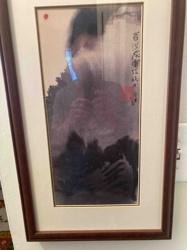
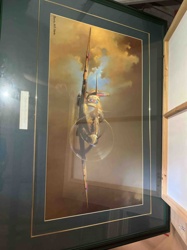
This item is a framed ink wash painting, likely a reproduction, depicting a natural scene with trees and birds. The artwork itself is rendered in black and gray tones on a light-colored, possibly off-white, paper that exhibits significant creasing and wrinkling, giving it a textural, almost aged appearance. The subject matter features several vertical tree trunks and branches, with two prominent, thicker trunks positioned in the mid-ground. Various birds are depicted; one appears to be in flight in the upper left, while at least two others are perched on branches in the lower and middle sections of the composition. The style is somewhat abstract and impressionistic, characterized by bold brushstrokes, particularly for the tree trunks, and lighter, more delicate marks for the foliage and birds. The overall color palette is monochromatic, relying on the interplay of ink density and the paper's texture for visual interest. A signature, 'Roadies' or 'Rhoades' (difficult to decipher definitively from the image), is visible in the lower left corner of the artwork. The artwork is housed within a silver-toned frame that features a 'bamboo' or 'reeding' motif, suggesting a decorative, possibly mid-20th century, aesthetic. The frame appears to be made of wood or a composite material with a metallic finish, with observable wear, particularly along the edges and corners, indicating some age and handling. A wide, off-white or cream-colored mat surrounds the artwork, providing a visual border and separating it from the frame. The artwork is protected by a sheet of glass or acrylic, which shows reflections from external lighting, making it difficult to assess the artwork's precise condition, though no immediate damage such as tears or significant stains are discernible beyond the intentional creasing of the paper. The frame's condition, with its scuffs and minor abrasions, suggests it is not new, and the choice of frame style could hint at its period of framing, potentially mid to late 20th century. The deliberate creasing of the paper is a unique aspect, contributing to its artistic character, though it could also be a method to simulate age or a specific paper type.
AI Appraisal Report
I have examined the provided image of the framed ink wash landscape with birds. The artwork appears to be a reproduction, possibly created with deliberate creasing of the paper to simulate age or add texture. The monochromatic ink wash style, while aesthetically pleasing, is not unique, and the signature 'Roadies' or 'Rhoades' is indistinct, making artist authentication challenging from an image alone. The 'bamboo' style silver-toned frame suggests a mid-to-late 20th-century origin, and its condition shows wear consistent with its age and handling. The wide mat is appropriate for the piece.
My assessment of condition for the artwork itself, beyond the intentional creasing, is difficult due to reflections on the glazing, but no obvious damage like tears or significant staining is visible. The frame's wear is noted but not severe enough to significantly detract from its decorative appeal.
Market conditions for unsigned or unattributed decorative art reproductions like this are generally modest. While the aesthetic is appealing, demand is typically for home decor rather than investment. Rarity is low given its likely status as a reproduction and the commonality of the subject matter and style. Key factors impacting value are the unknown artist, the likely reproduction status, and the decorative rather than fine art classification.
For full authentication, an in-person examination would be crucial to determine the print medium (e.g., offset lithograph, giclée, or original ink wash), the paper's actual age and composition, and a clearer view of the signature for artist research. Provenance documentation would also be vital for attributing it to a specific artist or period definitively. Scientific testing could verify ink composition and paper age if necessary. Without these, its value remains in the decorative art category.