AI estimate as of December 1, 2025 · verify with a professional before acting
AI-Generated · Verify before acting
Everything on this page is generated by AI for informational purposes only. AI can make mistakes — the AI may misidentify items or misattribute them (artist, maker, brand, designer, origin, era). This is not an official valuation and should not be used for insurance, sale, tax, estate, legal, or lending purposes — or any decision requiring a certified appraisal. It is not an authoritative claim about any person, brand, or rights holder — do not share or rely on it as a factual statement about a third party. Always consult qualified professionals before making financial decisions.
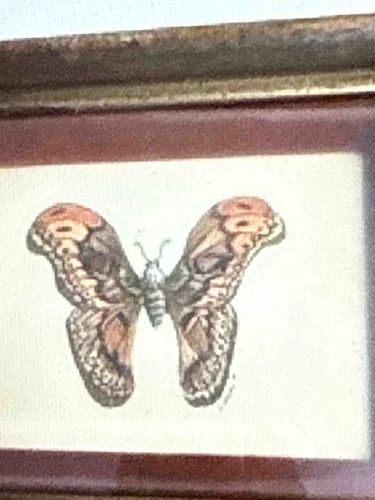
This item is a framed piece featuring a depiction of a butterfly or moth. The artwork itself appears to be a print or a highly detailed watercolor painting, showing a single large butterfly with substantial wingspan relative to its body. The dominant colors in the butterfly's wings are various shades of brown, black, and a muted reddish-orange, forming intricate patterns and 'eyespots,' particularly noticeable on the upper wings. The body of the insect is a lighter greyish-white with visible segmentation, and small antennae are present. The background of the artwork is a plain, light cream or off-white color, suggesting a minimalist presentation of the subject. The artwork is housed within a wooden frame, which has a reddish-brown or burgundy inner border, and an outer border that appears to be gold-toned or brass-colored, exhibiting some signs of wear, possibly showing darker patination or chipped gilt on the upper edge. The frame's construction seems traditional with visible corners where the wood meets. The overall condition of the artwork within the frame appears good, though the image resolution makes it difficult to assess fine details like paper discoloration or media integrity. The style suggests a botanical or entomological illustration typical of the late 19th to mid-20th century, often found in nature studies or decorative art. The craftsmanship, particularly the detailed illustration of the butterfly, indicates a good quality piece, likely mass-produced as a decorative print or a carefully rendered, unique painting.
AI Appraisal Report
This framed piece appears to be a print, or potentially a highly detailed watercolor, of a single large butterfly. The details of the insect are finely rendered, with intricate brown, black, and reddish-orange patterns, characteristic of entomological illustrations. The background is a stark, light cream, bringing the butterfly into sharp focus. The frame, a reddish-brown inner border with a gold-toned outer rim, shows some wear, particularly chipping on the gold finish, which aligns with common aging for late 19th to mid-20th century decorative frames. The artwork itself appears to be in good condition, with no visible discoloration or damage, though precise assessment is difficult from the image resolution.
Market conditions for natural history prints and decorative art of this period are steady, but not experiencing significant spikes unless the artist is well-known or the piece possesses unique qualities. Similar vintage butterfly prints or watercolors, even unsigned, typically fall into the $75-$150 range. If this were a unique, signed watercolor by a recognized artist, the value would be significantly higher. However, without a signature visible or provenance, it's safer to categorize it as a decorative print or unsigned artwork.
Factors impacting value include the potential for this to be an original painting, which I cannot definitively confirm from photographs. An in-person examination would be crucial to determine the medium (print vs. painting), the quality of the paper, and whether it bears a signature or any artist's marks. Without physical inspection, provenance documentation, or scientific testing of the media, authenticity as an original artwork, especially by a specific artist, cannot be verified. Currently, its value is based on its decorative appeal and condition as a vintage framed piece.