AI estimate as of November 23, 2025 · verify with a professional before acting
AI-Generated · Verify before acting
Everything on this page is generated by AI for informational purposes only. AI can make mistakes — the AI may misidentify items or misattribute them (artist, maker, brand, designer, origin, era). This is not an official valuation and should not be used for insurance, sale, tax, estate, legal, or lending purposes — or any decision requiring a certified appraisal. It is not an authoritative claim about any person, brand, or rights holder — do not share or rely on it as a factual statement about a third party. Always consult qualified professionals before making financial decisions.
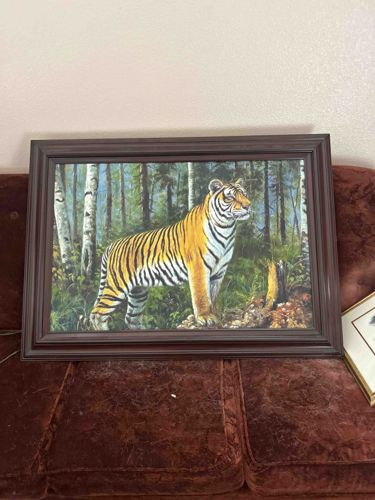
This item is a framed artistic representation of a tiger standing in a forest setting. The artwork, which appears to be either a print or a painting, depicts a majestic tiger with prominent orange fur patterned with distinctive black stripes. The tiger is positioned in profile, facing right, with its head slightly turned, suggesting it is observing its surroundings. The background features a dense forest with several tall, light-barked trees, possibly birch, creating a striking contrast with the darker green foliage and undergrowth. The ground in the foreground shows earthy tones with some scattered leaves and plants.
The artwork is enclosed within a dark brown, possibly wood or wood-composite, frame with a subtle, molded profile, indicative of a classic or traditional style. The frame appears to be in good condition with no immediately visible significant damage, chipping, or scratches. Due to the clarity of the image, it is difficult to ascertain the exact medium (oil, acrylic, print, etc.) or if there are any artist signatures or markings, though none are evident from this distance. The overall aesthetic suggests a piece intended for decorative display, likely from the mid-to-late 20th century or early 21st century, given its common framing style. No visible condition issues such as tears, fading, or moisture damage are apparent on the artwork itself. The quality of the reproduction or original seems good, with clear details and vibrant colors.
AI Appraisal Report
Upon visual examination of the provided image, I assess this framed tiger in a forest artwork as being in good overall condition. The artwork itself shows no immediately apparent flaws such as tears, fading, or moisture damage. The colors appear vibrant, and the details are clear, suggesting good quality reproduction or original work. The dark brown molded frame also appears to be in good condition, free from visible significant damage, chips, or scratches, consistent with a well-maintained decorative piece.
Due to the limitations of image-based appraisal, I cannot definitively determine the medium; it could be a print (lithograph, giclee, etc.) or an original painting (oil, acrylic). No artist's signature or provenance documentation is visible, which significantly impacts its potential intrinsic value. Without an artist attribution, whether it is a print or painting, it is primarily valued as decorative wall art.
Market conditions for unsigned, general decorative art depicting wildlife are generally modest. Similar framed prints or paintings of tigers, especially without a known artist or limited edition status, typically sell in the low to mid-range. Demand for such items is steady but not high, as they are commonly available in various retail channels. Rarity is not a factor here; this subject matter is quite common.
Factors significantly impacting value include the lack of an identifiable artist and the undetermined medium. If it were confirmed to be an original painting by a recognized artist, the value would obviously be much higher. Without such verification, it functions purely as an aesthetic enhancement for a room.
For full authentication and a more precise valuation, an in-person examination would be crucial to determine the exact medium (original paint application vs. print), look for any hidden signatures, assess the quality of materials, and potentially identify printing techniques. Provenance documentation, if available, would also be invaluable. Scientific testing (e.g., pigment analysis) could further clarify its originality, but this is typically reserved for higher-value pieces.