AI Appraisal Estimate

AI-generated estimates · not official valuations

From the user

What was submitted

Photo and notes provided by the user — not generated by AI

Submitted item photo
Submitted photo · July 2, 2026

User's notes

Wood

AI analysis below

AI appraisal

AI analysis & estimate

AI-Generated · Verify before acting

Everything below is generated by AI for informational purposes only. AI can make mistakes — the AI may misidentify items or misattribute them (artist, maker, brand, designer, origin, era). This is not an official valuation and should not be used for insurance, sale, tax, estate, legal, or lending purposes — or any decision requiring a certified appraisal. It is not an authoritative claim about any person, brand, or rights holder — do not share or rely on it as a factual statement about a third party. Always consult qualified professionals before making financial decisions.

Note

This analysis also relies on unverified notes provided by the user, which may be incomplete or inaccurate and could affect the result.

Read the full disclaimer

AI Identification

·Not independently authenticated·Verify before acting

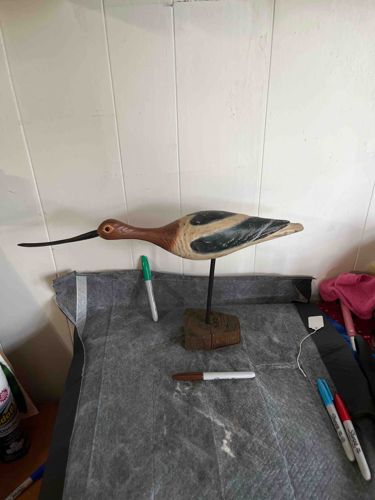
Carved Wooden Shorebird Decoy on Stand

Folk Art Carving

AI Estimated Value

·Not an official valuation·Verify before acting

$150-250

As of July 2, 2026

AI Item Analysis

·AI can make mistakes·Verify before acting
This item is a carved wooden decoy or decorative sculpture depicting a shorebird, likely a curlew or godwit, mounted on a wooden stand. The bird's body is elongated with a distinct, long, downward-curving black beak. The head and neck are painted in a reddish-brown or fawn color, transitioning to a lighter, possibly off-white or light tan, mid-section of the body. The back and wings are primarily dark, likely black or very dark brown, with prominent cream or light tan streaks or markings, suggesting feather patterns. The eyes are small and appear to be painted circles of a darker color, possibly black, with a lighter ring around them. The carving displays a relatively smooth finish, indicative of a certain level of craftsmanship. The bird is attached to a dark, slender metal rod that is inserted into a rectangular, rough-hewn block of wood, serving as the base. The base itself appears weathered, featuring visible wood grain and some surface irregularities, consistent with aged wood. There are no readily visible maker's marks or signatures from the provided image. The overall style suggests a folk art or traditional decoy carving aesthetic, possibly from the mid-20th century or later, designed for decorative purposes rather than hunting. The condition appears good for its type, with some minor wear or natural aging expected on the painted surfaces and wooden base. The simplicity of its construction and hand-painted details suggest a handcrafted piece.
AI Appraisal Report

·AI can make mistakes·Verify before acting
Upon examining the image of this carved wooden shorebird decoy, which appears to depict a curlew or godwit, I assess its overall condition as good. The painted surfaces show expected minor wear consistent with its likely age and decorative purpose. The hand-painted details, smooth finish, and choice of wood (as indicated by the owner) suggest a handcrafted folk art piece. The distinct long, downward-curving black beak and the striking contrast of the reddish-brown head/neck with the dark streaked back are characteristic of such carvings. The metal rod mounting into a weathered, rough-hewn wooden base further reinforces its folk art aesthetic, suggesting it was created for display rather than as a functional hunting decoy. These types of decorative shorebird carvings are popular in the folk art market. Demand is steady for well-executed pieces, though true rarity is uncommon unless attributed to a highly sought-after carver. Comparables in similar condition and style typically fetch between $100 and $300 at auction or in specialized folk art galleries. Factors impacting its value negatively include the absence of a discernible maker's mark or signature, which limits its collectibility in the absence of provenance. Authentication from images alone is limited. A physical examination would allow for a detailed inspection of the wood type, carving techniques, paint application, and assessment of age through patination that cannot be fully determined from photographs. Specifically, microscopic analysis of paint layers could differentiate original paint from later touch-ups, and a close examination of the wood grain might reveal more about its age. Provenance documentation, such as records of purchase or ownership history, would be crucial for establishing authenticity and attributing it to a specific carver or region. Without these, it remains a charming, decorative folk art piece.

Get your items appraised

Instant estimates of your treasures with AI-powered appraisals

Browse More Appraisals