AI Appraisal Estimate

AI-generated estimates · not official valuations

From the user

What was submitted

Photo and notes provided by the user — not generated by AI

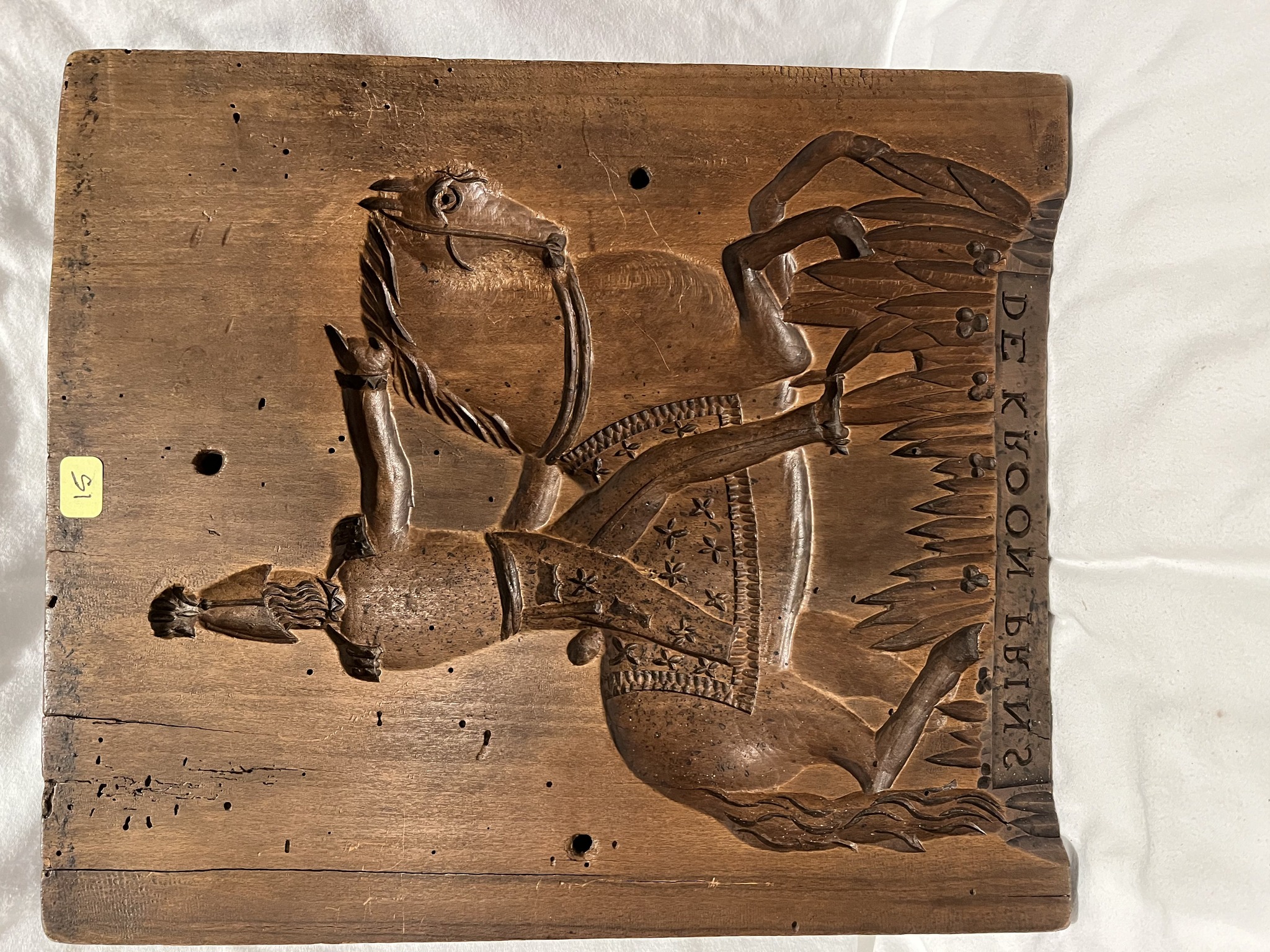
Submitted item photo
Submitted photo · June 20, 2026

User's notes

This rare pair of antique Dutch Koekplanks, likely 18th or 19th century, was hand-carved from hardwood, possibly oak or walnut for shaping speculaas cookies. Each measures 11 x 13 x 1 inches (4 lbs) and features a mirrored design of a mounted soldier in uniform—adorned with stars, epaulettes, and a plumed hat—set against grass, with the inscription “DE KROON PRINS,” referencing Dutch royalty, likely honoring a Crown Prince of the House of Orange. Condition is good, with small wormholes, stable cracks, and patina, no active infestation or repairs. In 1951, Dr. and Mrs. Charles Gould, while living in Haarlem during his flower bulb research at the Bloembollen Institute in Lisse, sought high-quality Dutch antiques with Mien Sabelis, the sister of Ted Sabelis, a well-respected flower bulb wholesaler in Washington State, USA. They found no Koekplanks that met their standards at that time; however, in 1953, Mien located and gifted this pair, hand-carrying them to the Goulds in Puyallup, WA.

AI analysis below

AI appraisal

AI analysis & estimate

AI-Generated · Verify before acting

Everything below is generated by AI for informational purposes only. AI can make mistakes — the AI may misidentify items or misattribute them (artist, maker, brand, designer, origin, era). This is not an official valuation and should not be used for insurance, sale, tax, estate, legal, or lending purposes — or any decision requiring a certified appraisal. It is not an authoritative claim about any person, brand, or rights holder — do not share or rely on it as a factual statement about a third party. Always consult qualified professionals before making financial decisions.

Note

This analysis also relies on unverified notes provided by the user, which may be incomplete or inaccurate and could affect the result.

Read the full disclaimer

AI Identification

·Not independently authenticated·Verify before acting

Carved wooden cookie mold in the Dutch Koekplank style

Wood Carvings & Folk Art

AI Estimated Value

·Not an official valuation·Verify before acting

$1,500 - $2,500

As of June 20, 2026

AI Item Analysis

·AI can make mistakes·Verify before acting
This item is a thick, rectangular wooden board featuring a deeply intaglio-carved relief, stylistically consistent with a traditional Dutch 'Koekplank' used for shaping speculaas or gingerbread. The carving depicts a mounted equestrian figure, possibly a soldier or royal personage, wearing a plumed hat and uniform with star motifs. The horse is shown in a dynamic pose above a stylized grassy ground. Along the right vertical edge, the board bears a reversed hand-carved inscription reading 'DE KROON PRINS' (The Crown Prince), which would appear correctly oriented when pressed into dough. The wood displays a rich, dark brown patina and visible grain consistent with a dense hardwood such as oak or walnut. Condition features include numerous small circular holes, likely historic insect damage (wormholes), several vertical hairline cracks, and softened edges from handling. The owner attributes this piece to 18th or 19th-century Dutch origin with a specific provenance involving the House of Orange and a 1950s acquisition in Haarlem; however, these historical claims are unverified without laboratory testing or formal archival appraisal. A small yellow adhesive label with the number '15' is present on the left side of the block, likely from a previous inventory or auction.
AI Appraisal Report

·AI can make mistakes·Verify before acting
Based on the provided images and documentation, this pair of carved wooden 'Koekplank' molds is attributed to 18th or 19th-century Dutch craftsmanship. The intaglio carving of 'DE KROON PRINS' (The Crown Prince) and the equestrian figure suggest a commemorative or royal theme. The dark patina and visible insect damage are consistent with aged hardwood, although I cannot verify the wood species or the age of the oxidation from a photograph alone. Per the user submission, the items are associated with the House of Orange and have been in the United States since the 1950s. While this provenance is compelling, I treat it as a hypothesis that would require verification through archival research or dendrochronological testing. The value estimate of $1,500 - $2,500 assumes the items are period-original carvings. This range reflects the rarity of found pairs and the high market demand for Dutch folk art with royal iconography. If these were determined to be late 19th-century reproductions or mid-20th-century decorative copies, the value would likely drop to $200 - $400. In my examination, the softened edges suggest significant usage/handling, but I cannot rule out intentional distressing without an in-person inspection. These molds represent a significant intersection of culinary history and political folk art. To confirm the high-end estimate, I would recommend a physical examination to check for residue in the carvings and to evaluate the consistency of the tool marks with period hand-tools. The presence of nineteenth-century inventory labels adds to the circumstantial evidence of age, but these markings can be added later and do not serve as proof of origin.

Get your items appraised

Instant estimates of your treasures with AI-powered appraisals

Browse More Appraisals