AI estimate as of October 14, 2025 · verify with a professional before acting
AI-Generated · Verify before acting
Everything on this page is generated by AI for informational purposes only. AI can make mistakes — the AI may misidentify items or misattribute them (artist, maker, brand, designer, origin, era). This is not an official valuation and should not be used for insurance, sale, tax, estate, legal, or lending purposes — or any decision requiring a certified appraisal. It is not an authoritative claim about any person, brand, or rights holder — do not share or rely on it as a factual statement about a third party. Always consult qualified professionals before making financial decisions.
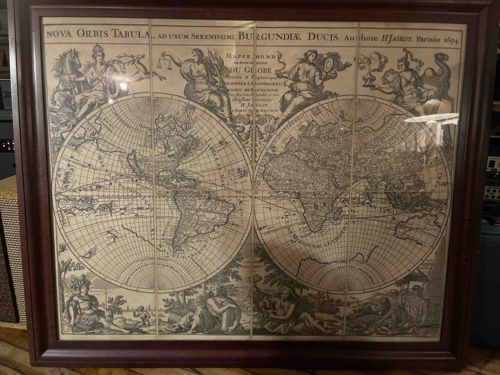
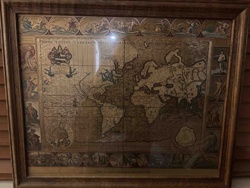
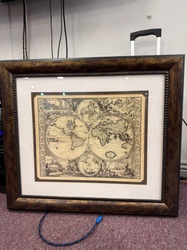
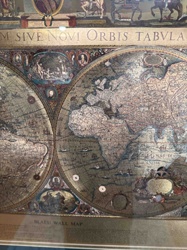
This item is a framed reproduction of an antique world map titled 'Nova Orbis Tabula,' originally authored by H. Jaillot in Paris in 1694. The map is presented as two large hemispheric projections, depicting the Western and Eastern hemispheres, complete with latitude and longitude lines. The cartography appears to be a black and white or sepia-toned print, giving it an aged aesthetic, possibly on a cream or light tan paper background resembling parchment. The map is richly decorated with allegorical figures and mythological scenes in the spandrels and along the bottom border. In the upper corners, figures are depicted on horseback, some holding scales and musical instruments, while the lower corners show reclining figures and cherubs in pastoral settings. The map itself displays continents, islands, and bodies of water with historical nomenclature. Notably, 'America' is clearly visible in the left hemisphere, and 'Africa' and 'Asia' are prominent in the right. The print is sectioned into multiple rectangular segments, likely printed separately and then assembled, creating subtle grid lines across the image, which may indicate a tile-based printing method or how the reproduction was formatted. The entire piece is housed in a substantial wooden frame with a dark, possibly mahogany or cherry, reddish-brown stain, featuring a classic, slightly ornate profile. There is a protective glass or plexiglass covering, which reflects light in various areas, indicating its presence. The condition appears good for a reproduction, with no obvious tears or significant damage visible on the map itself, though reflections obscure some details. The frame shows no visible signs of major wear or damage from this distance. The overall aesthetic suggests it is a decorative piece, aiming to emulate the grandeur and historical significance of 17th-century cartography while being a modern creation.
AI Appraisal Report
Upon examination of the 'Nova Orbis Tabula' map, it is my professional opinion that this is a modern decorative reproduction of the original 1694 work by H. Jaillot. The piece is presented as a high-quality print, possibly a giclée or lithograph on aged-looking paper, designed to emulate the aesthetic of the 17th-century original. It is handsomely presented in a substantial, traditionally styled wooden frame under glass, and the overall condition of both the print and frame appears to be excellent, with no visible signs of damage.
The value of this item is determined by its decorative appeal rather than its historical or cartographic significance. The market for such high-quality reproductions is consistent, with demand driven by interior design trends. Comparable large, framed decorative map reproductions of this style and quality typically sell in the secondary market for between $150 and $250. The value is primarily in the quality of the print, the framing, and its large, impressive size, which makes it a desirable decorative wall piece.
It is crucial to note that this appraisal is based solely on visual analysis from images and assumes the item is a modern reproduction as indicated by its appearance. Authentication of an original 17th-century map would require in-person examination to assess the paper type, watermark, printing technique (intaglio print), and any physical signs of aging. Without provenance documentation or physical inspection, this piece must be valued as a decorative object.