AI Appraisal Estimate

AI-generated estimates · not official valuations

From the user

What was submitted

Photo and notes provided by the user — not generated by AI

Submitted item photo
Submitted photo · June 6, 2026

User's notes

No additional notes provided.

AI analysis below

AI appraisal

AI analysis & estimate

AI-Generated · Verify before acting

Everything below is generated by AI for informational purposes only. AI can make mistakes — the AI may misidentify items or misattribute them (artist, maker, brand, designer, origin, era). This is not an official valuation and should not be used for insurance, sale, tax, estate, legal, or lending purposes — or any decision requiring a certified appraisal. It is not an authoritative claim about any person, brand, or rights holder — do not share or rely on it as a factual statement about a third party. Always consult qualified professionals before making financial decisions.

Read the full disclaimer

AI Identification

·Not independently authenticated·Verify before acting

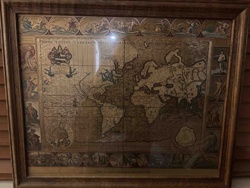
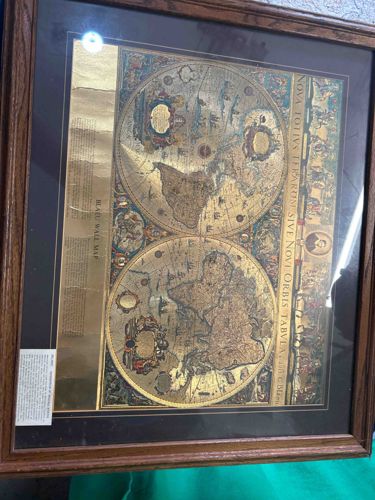
Framed Gold Foil Reproduction of Willem Blaeu's 'Nova Totius Terrarum Orbis Geographica ac Hydrographica Tabula' World Map

Decorative Arts / Cartographic Reproductions

AI Estimated Value

·Not an official valuation·Verify before acting

$40 - $75

As of June 6, 2026

AI Item Analysis

·AI can make mistakes·Verify before acting
This item is a decorative world map reproduction, specifically modeled after the famous 17th-century cartography of Willem Blaeu. The piece is a modern commemorative or decorative edition (likely mid to late 20th century) featuring a double-hemisphere projection. It is rendered on a reflective metallic gold foil surface, which provides a high-contrast, lustrous background for the intricate black and colored inks used for the geography and ornate illustrations. The map includes the signature Latin title 'NOVA TOTIUS TERRARUM SIVE NOVI ORBIS TABULA' along the border, accompanied by various allegorical figures and vignettes of historical figures and scenes. Physically, the map is mounted on a dark, possibly navy or black matboard, which helps the metallic gold pop visually. It is housed in a substantial solid wood frame with a visible grain, likely oak, possessing a medium brown stain. The craftsmanship is industrial-grade rather than artisanal, targeting the giftware or home decor market. Notable markings include text on the left margin identifying it as a 'BLAEU WALL MAP' and a descriptive label in the lower left corner detailing the history of the original 1648 map. The condition appears fair to good; there is some minor warping or rippling visible in the foil surface under the glass, and the frame shows light scuffing along the edges consistent with age and handling. The use of gold foil suggests a 1970s or 1980s aesthetic when such metallic wall art was popular.
AI Appraisal Report

·AI can make mistakes·Verify before acting
I have conducted a visual examination of this framed metallic gold foil reproduction of Willem Blaeu’s 17th-century world map. Based on the construction, typography, and material choice, this piece is a modern decorative reproduction produced circa 1970–1985. It is not an original antique engraving, but rather a mass-produced item intended for the mid-market home decor sector, likely distributed by companies such as Turner Manufacturing or similar commercial art houses. The condition is fair to good. I observe noticeable undulation (rippling) of the foil substrate, a common issue caused by moisture or thermal expansion/contraction of the metallic layer against its backing. The oak frame shows minor abrasions. In the current secondary market, demand for mid-century 'gold foil' maps is stable but primarily driven by interior design trends rather than cartographic rarity. Similar items frequently appear at estate auctions and secondary marketplaces with realized prices typically under $100. Factors limiting the value include its mass-produced nature and the condition of the foil. While the visual impact is high, it lacks the hand-colored detail and paper texture sought by serious collectors of antiquarian maps. Limitations: This appraisal is based solely on digital images. Without a physical inspection, I cannot verify if the frame is solid hardwood or a veneer, nor can I examine the map out of the frame to check for Foxing or UV damage beneath the matting. A physical examination would be required to confirm the exact printing process and identify any hidden structural damage to the mounting. No provenance was provided, though it would not significantly alter the value of a modern reproduction.

Get your items appraised

Instant estimates of your treasures with AI-powered appraisals

Browse More Appraisals