These notes were written by the person who submitted this item. Appraiser.AI has not verified them, and the AI's identification and estimate may rely on them.
AI Estimated Value
Not an official valuation
$5 - $15
AI estimate as of November 10, 2025 · verify with a professional before acting
AI-Generated · Verify before acting
Everything on this page is generated by AI for informational purposes only. AI can make mistakes — the AI may misidentify items or misattribute them (artist, maker, brand, designer, origin, era). This is not an official valuation and should not be used for insurance, sale, tax, estate, legal, or lending purposes — or any decision requiring a certified appraisal. It is not an authoritative claim about any person, brand, or rights holder — do not share or rely on it as a factual statement about a third party. Always consult qualified professionals before making financial decisions.
This analysis also relies on unverified notes provided by the user, which may be incomplete or inaccurate and could affect the result.
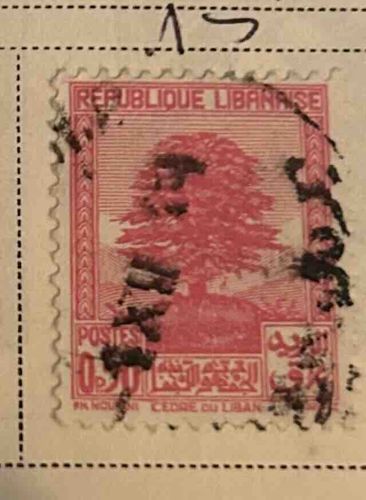
This is a rectangular, 'used' postage stamp from 'REPUBLIQUE LIBANAISE' (Republic of Lebanon), featuring a prominent illustration of a cedar tree. The primary color of the stamp, including the tree and much of the text, is a reddish-pink or salmon hue, set against a lighter, possibly white or cream-colored, background that suggests aged paper. The stamp has perforated edges, indicating it was torn from a sheet. Visible markings include 'REPUBLIQUE LIBANAISE' at the top, 'POSTES' on the left, and a denomination of '50' (presumably centimes or piastres) near the bottom left, though some numbers are obscured by cancellations. Below the main image, illegible Arabic script is present, along with 'HN MONT CEDRE DU LIBAN'. The overall condition shows significant wear, notably heavy cancellations in black ink that obscure parts of the design, particularly the tree itself and the denomination. There are also smaller black ink marks on the upper right side. The perforations are intact but show some minor fraying. The paper appears to be of standard stamp paper quality, with a slightly textured finish. The design of the cedar tree, a national symbol of Lebanon, is a classic motif for Lebanese postage. The presence of 'HN MONT CEDRE DU LIBAN' suggests a thematic connection to the 'Cedar of Lebanon' found on Mount Lebanon. Given the design and French inscription, the stamp likely dates from a period when French influence was significant in Lebanon, potentially from the mid-20th century. The 'used' condition, indicated by the cancellation marks, means it has served its purpose in mail delivery.
AI Appraisal Report
Based on my examination of the provided image of the Lebanese Cedar Tree Postage Stamp (Used), I assess its condition as 'used' with significant wear. The heavy black ink cancellations obscure much of the design, including the tree and denomination, which negatively impacts visual appeal and, consequently, value. Authenticity appears consistent with known Lebanese issues from the mid-20th century, given the 'REPUBLIQUE LIBANAISE' and French inscriptions. However, without physical inspection, I cannot verify watermarks, paper thickness/texture, or printing details that would confirm authenticity definitively. Minor fraying on the perforations is also noted.
In terms of market conditions, this appears to be a common thematic stamp for Lebanon. Used stamps generally command lower prices than unused (mint) examples, especially when heavily cancelled. Stamps from this era and region, unless rare varieties or high denominations in pristine condition, typically fall into the lower end of the collecting market. Comparable stamps in similar, heavily cancelled condition often sell for a few dollars. Demand for common, used Lebanese stamps is generally moderate, primarily from thematic collectors of cedar trees, Middle Eastern philately, or general worldwide collectors.
The significant cancellation is the primary factor impacting its value negatively. While the cedar tree is a popular national symbol, this specific example's condition limits its desirability and potential market price. For a full authentication that goes beyond visual assessment, an in-person examination would be necessary to check for common reprints or forgeries, assess the gum (if present on the reverse, though unlikely for a used stamp), and verify paper and printing nuances. Provenance documentation could also support its history.