AI estimate as of November 9, 2025 · verify with a professional before acting
AI-Generated · Verify before acting
Everything on this page is generated by AI for informational purposes only. AI can make mistakes — the AI may misidentify items or misattribute them (artist, maker, brand, designer, origin, era). This is not an official valuation and should not be used for insurance, sale, tax, estate, legal, or lending purposes — or any decision requiring a certified appraisal. It is not an authoritative claim about any person, brand, or rights holder — do not share or rely on it as a factual statement about a third party. Always consult qualified professionals before making financial decisions.
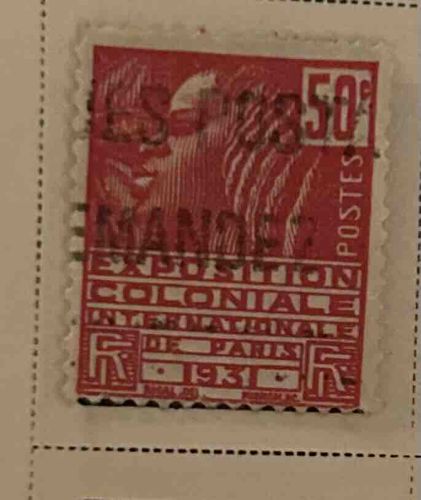
This item is a postage stamp from Madagascar, issued to commemorate the 1931 Paris Colonial Exposition. The stamp is predominantly red in color with white or very light-colored text and imagery. It features a portrait of a person, likely a colonial figure or allegorical representation, with a headdress or flowing hair, set against a background of what appears to be a landscape or abstract pattern. The top right corner clearly displays the denomination '50c' (50 centimes) and the word 'POSTES' vertically along the right edge. Below the portrait, several lines of text are visible in white lettering, which read 'EXPOSITION COLONIALE INTERNATIONALE DE PARIS 1931'. On the bottom left and right, there are stylized 'R' or 'FR' designs, potentially signifying 'République Française' or related colonial governance. The stamp has perforated edges, indicating it was part of a sheet. The overall condition appears to be good for its age, though slight fading or discoloration is possible given the image quality. There are no obvious tears, creases, or major damage visible. The printing quality suggests a standard philatelic production for its era, with clear if somewhat aged, imagery and text. The detailed lettering and design elements point to a specific commemorative issue, highlighting a significant historical event.
AI Appraisal Report
This Madagascar 1931 Paris Colonial Exposition 50c stamp appears to be in good, used condition based on the provided image. The perforations seem intact, and there are no immediately obvious tears, creases, or major damage, though a light cancel may be present, which would indicate it is used. The image quality makes it difficult to ascertain the exact shade of red or the presence of subtle toning/discoloration, common for stamps of this age.
Authenticity, based solely on this image, seems probable. This is a common issue from the 1931 colonial exhibition series. While forgeries exist for more valuable stamps, this particular denomination and design generally do not attract high-quality counterfeiting that would be undetectable from a clear image.
Market conditions for this specific stamp are generally modest. It is not considered rare. Comparables for this stamp in good, used condition typically range from $2 to $5, sometimes slightly more if it has a particularly fine cancellation or is part of a desirable collection. Demand is primarily from collectors focusing on French colonial issues or worldwide exhibition stamps.
Factors impacting value would include gum condition (if unused), the presence and quality of any cancellation (if used), centering, and any hidden flaws such as thins, creases, or repairs that are not visible in the provided image. The overall visual appeal is decent, but nothing suggests it is a premium example.
Limitations: A full authenticity verification and precise condition assessment would require in-person examination. I would need to check for hidden thins, repairs, precise color variations, and the exact nature of any cancellation. Verifying gum condition (if unused) is impossible without physical inspection. While unlikely for this stamp, microscopic examination could confirm printing methods and detect potential alterations or expert forgeries. Provenance documentation, while always helpful, is not typically robust for such common issues.