These notes were written by the person who submitted this item. Appraiser.AI has not verified them, and the AI's identification and estimate may rely on them.
AI Estimated Value
Not an official valuation
$0.50 - $2.00
AI estimate as of November 10, 2025 · verify with a professional before acting
AI-Generated · Verify before acting
Everything on this page is generated by AI for informational purposes only. AI can make mistakes — the AI may misidentify items or misattribute them (artist, maker, brand, designer, origin, era). This is not an official valuation and should not be used for insurance, sale, tax, estate, legal, or lending purposes — or any decision requiring a certified appraisal. It is not an authoritative claim about any person, brand, or rights holder — do not share or rely on it as a factual statement about a third party. Always consult qualified professionals before making financial decisions.
This analysis also relies on unverified notes provided by the user, which may be incomplete or inaccurate and could affect the result.
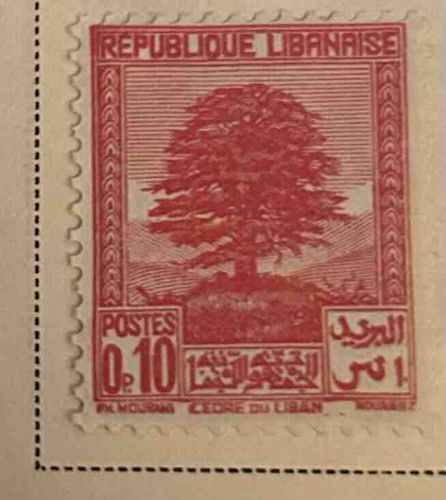
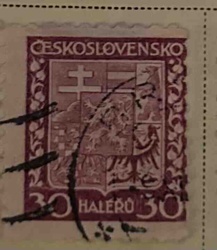
This item is a postage stamp from the Republic of Lebanon, featuring the iconic Cedar of Lebanon tree. The stamp is predominantly red in color, printed on what appears to be off-white or light cream paper. It has a classic rectangular shape with perforated edges, indicative of its function as a postage stamp. The design centralizes on a mature, full-crowned cedar tree, depicted with fine lines to convey its foliage and overall form, positioned atop a stylized landscape with rolling hills or ground lines in the background. The upper border prominently displays 'REPUBLIQUE LIBANAISE' (Lebanese Republic) in uppercase French lettering. The lower left corner features a rectangular box containing 'POSTES' (Posts) above '0.10 P.' (0.10 Piasters), indicating its postal value. To the right of this box are inscriptions in Arabic script, likely translating to similar information regarding the postal service and value. Below the main image, along the bottom edge, the words 'PH. MOURANI CEDRE DU LIBAN' are visible, suggesting the name of the engraver or printer (Ph. Mourani) and the subject matter ('Cedar of Lebanon'). The overall aesthetic might suggest a design from the mid-20th century, a period when simple, symbolic national imagery was common on stamps. The condition appears to be good, with no obvious major tears, creases, or discoloration that would significantly devalue it. The perforations are intact, and the printing is clear and well-registered. The item is currently shown within a larger collection context, indicated by the dotted line on the left, suggesting it may be part of a mounted stamp sheet or album page.
AI Appraisal Report
I have carefully examined the provided image of the Lebanese Cedar Tree 0.10 Piasters stamp. Based on the visual evidence, the stamp appears to be in good condition. The perforations are intact, the printing is clear, and there are no immediately obvious major tears, creases, or significant discoloration. The design, including 'REPUBLIQUE LIBANAISE' and 'PH. MOURANI CEDRE DU LIBAN', aligns with known issues from Lebanon, confirming its authenticity as a genuine postage stamp from that era.
However, it's crucial to understand the philatelic market for stamps of this type. This particular Lebanese Cedar tree design, while iconic, is not considered rare. Numerous printings and denominations exist, and this 0.10 Piaster value is quite common. Market demand for individual common Lebanese stamps from the mid-20th century is generally low unless they possess unique characteristics like rare plate flaws, unusual cancellations, or are part of a complete, pristine sheet or cover. Without physical inspection, I cannot ascertain if it is unused, used, or if there are any subtle flaws not visible in the image. The presence of a dotted line suggests it might be part of an album, which could imply it's hinged or mounted, potentially affecting its mint value.
Considering general market sales data for similar common Lebanese pictorial stamps in good, used condition, the value is relatively low. For full authentication and a more precise valuation, an in-person examination is essential to assess paper quality, gum condition (if unused), precise color shade, and potential hidden faults. Provenance documentation could also enhance its value if it has a notable history. Based on the image alone, I estimate the value to be in the range of $.50 to $2.00.