Agave Americana (Century Plant)
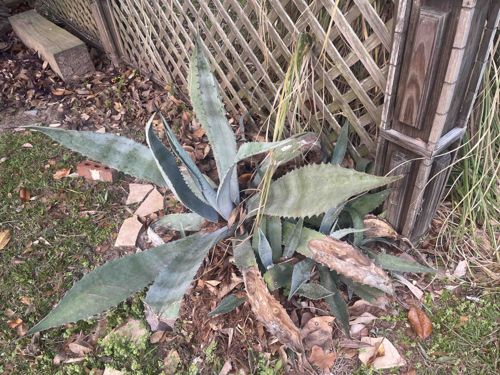
This is a specimen of Agave americana, commonly known as the Century Plant or Maguey. It features a large, succulent rosette formation of thick, lanceolate leaves. The leaves exhibit a characteristic glaucous blue-green or powder-grey color. Physically, the plant is characterized by its significant size, with leaves that appear roughly 2 to 3 feet in length, lined with sharp, marginal teeth and tipping into a terminal spine. The construction of the plant is naturally symmetrical, though this specimen shows some irregular growth. Regarding condition, the plant exhibits noticeable stress and damage: several lower leaves show significant browning, desiccation, and tip necrosis, likely due to cold damage, improper drainage, or natural senescence. There is visible leaf scarring and splitting on the fleshy surfaces. Debris, including dried leaves and organic lawn waste, is accumulated at the base. The plant is positioned in a suburban landscape setting near a wooden lattice fence and a decorative column. In an appraisal context, this would be graded as a mature specimen in poor-to-fair health, requiring significant pruning and horticultural care to restore aesthetic value.
AI-Generated Appraisal Disclaimer
Estimated Value
$150 - $250
Basic Information
Category
Botanical/Horticultural Specimens
Appraised On
March 7, 2026
Estimated Value
$150 - $250
Item Description
This is a specimen of Agave americana, commonly known as the Century Plant or Maguey. It features a large, succulent rosette formation of thick, lanceolate leaves. The leaves exhibit a characteristic glaucous blue-green or powder-grey color. Physically, the plant is characterized by its significant size, with leaves that appear roughly 2 to 3 feet in length, lined with sharp, marginal teeth and tipping into a terminal spine. The construction of the plant is naturally symmetrical, though this specimen shows some irregular growth. Regarding condition, the plant exhibits noticeable stress and damage: several lower leaves show significant browning, desiccation, and tip necrosis, likely due to cold damage, improper drainage, or natural senescence. There is visible leaf scarring and splitting on the fleshy surfaces. Debris, including dried leaves and organic lawn waste, is accumulated at the base. The plant is positioned in a suburban landscape setting near a wooden lattice fence and a decorative column. In an appraisal context, this would be graded as a mature specimen in poor-to-fair health, requiring significant pruning and horticultural care to restore aesthetic value.
Get Your Items Appraised
Instant estimates of your treasures with AI-powered instant appraisals